
Why Winter Surveillance Fails and How the SDL500 Engineered Design Solves the Cold Climate Challenge
For engineering teams and security distributors operating in regions like Canada, Germany, the UK, and the Northern United States, winter is the ultimate stress test for outdoor security systems. Traditional solar cameras often suffer from rapid battery depletion, lens fogging, or complete system shutdowns when temperatures drop below freezing. As an engineer with 13 years in solar security design, I have seen these failures lead to high maintenance costs and compromised site safety.
The core issue lies in the chemistry of standard lithium-ion batteries and the lack of specialized thermal management. When temperatures hit -10°C (14°F) or lower, the internal resistance of a standard battery increases significantly, reducing its effective capacity by up to 50%. This is where the SDL500 series differentiates itself, utilizing advanced BMS (Battery Management System) technology to ensure consistent power delivery even in harsh alpine conditions.
In this technical deep-dive, we will explore the engineering hurdles of winter surveillance and how the SDL500’s cold-resistant architecture provides a reliable solution for 4G operators, construction site managers, and wholesalers who cannot afford downtime.
The Technical Reality: Why Standard Solar Cameras Fail in Ice and Snow
Most off-the-shelf solar cameras use standard Li-ion cells that are designed for temperate climates. When exposed to sub-zero temperatures, these cells cannot accept a charge effectively from the solar panel, and discharging them at high rates can cause permanent capacity loss. Furthermore, snow accumulation on solar panels prevents the “trickle charge” necessary to keep the system alive during short winter days.
Beyond the battery, physical hardware faces challenges. Mechanical PTZ (Pan-Tilt-Zoom) motors can freeze if the lubricants used are not rated for low temperatures. Moisture ingress from melting snow can lead to internal condensation, fogging the lens and rendering the footage useless. These are the specific pain points we addressed when designing the SDL500.
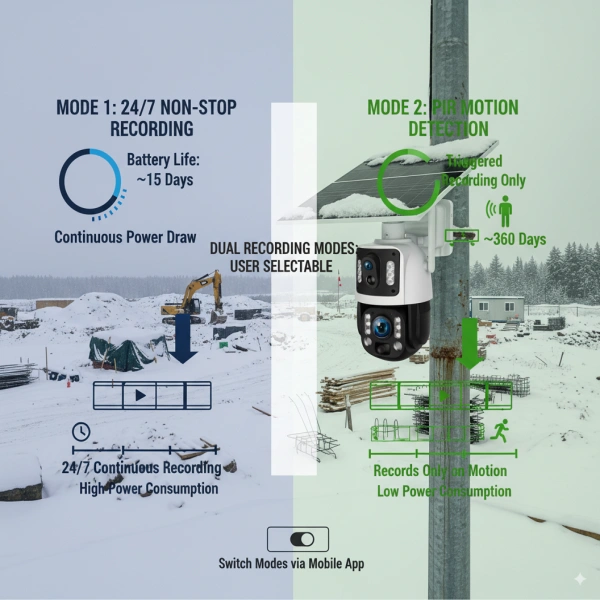
Core Solution: SDL500 Engineered Resilience
The SDL500 is not just a standard camera in a thicker shell; it is an integrated system designed for thermal efficiency. We have implemented a low-power consumption logic that prioritizes essential functions when battery levels are low, ensuring the 4G connection remains active even if the high-intensity floodlights are throttled.
One of the standout features is our Smart Dual-Light system. Traditional infrared (IR) night vision can sometimes reflect off falling snowflakes, creating “white-out” noise in the video feed. Our dual-lens and dual-light configuration allows the camera to intelligently switch between IR and warm white light, penetrating through light frost and snow to maintain clear image quality. This is particularly vital for building site security cameras where visibility is critical for liability protection.
Technical Comparison: SDL500 vs. Standard Solar Cameras
To understand the business value of investing in high-spec winter hardware, consider the following technical comparison based on field performance data in sub-zero environments.
| Feature | Standard Solar Camera | SDL500 Cold-Resistant Design |
|---|---|---|
| Battery Chemistry | Standard Li-ion (0°C to 45°C charge) | Low-temp NCM Cells (-20°C to 55°C) |
| BMS Protection | Basic Overcharge/Discharge | Active Thermal Monitoring & Current Limiting |
| Housing Material | Low-grade ABS Plastic (Brittle in cold) | Industrial-grade UV-resistant Polycarbonate/Alloy |
| Night Vision | Fixed IR (Reflective in snow) | Smart Dual-Light (IR + Full Color LED) |
| Connectivity | Basic WiFi (Range drops in moisture) | High-Gain 4G LTE with Signal Stabilization |
Application Case Study: High-Altitude Construction Site in Switzerland
Problem: A construction contractor in the Swiss Alps faced constant “Offline” issues with their previous 4G solar cameras during the December-February period. The frequent need for manual battery swaps was dangerous and costly due to the site’s remote location.
Solution: The team replaced the existing fleet with SDL500 units equipped with high-efficiency monocrystalline solar panels. These panels were mounted at a 60-degree angle to naturally shed snow and maximize low-angle winter sunlight. We also configured the low-power standby mode to extend the battery life during consecutive cloudy days.
Result: The SDL500 maintained 99.8% uptime throughout the winter season. The contractor saved an estimated $4,500 in labor costs previously spent on site visits for camera maintenance. The ability to monitor progress in real-time despite 2 meters of snow proved invaluable for project management.
Winter Troubleshooting and Maintenance Solutions
Even with superior hardware, successful winter surveillance requires a strategic approach. Based on our 13 years of production experience, here is a checklist for maintaining stability in ice and snow:
- Optimal Panel Angling: In winter, the sun sits lower on the horizon. Tilt your solar panels at a steeper angle (approx. 15-20 degrees more than your latitude) to catch more light and allow snow to slide off.
- Check the BMS Status: Utilize the Ubox app to monitor the battery voltage. If you notice a consistent drop, consider a long-range solar camera setup with a larger external panel.
- Lens Care: While the SDL500 has a specialized coating, excessive ice buildup should be cleared. Our “Smart Warm-up” feature uses internal heat generation to minimize lens frost.
- Signal Optimization: Cold, dense air and heavy snow can interfere with 4G signals. Ensure your camera is using high-gain antennas if you are in a fringe coverage area.
The Role of 4G in Remote Winter Monitoring
WiFi signals are notoriously unstable in harsh weather due to physical interference from ice and moisture. For professional applications, we always recommend 4G security cameras. The dedicated cellular connection provides a more robust data link, essential for remote locations like resorts, marinas, or energy stations.
Our experience shows that 4G-enabled solar cameras are the “ultimate solution” for construction sites and municipal projects where infrastructure is non-existent. The SDL500’s ability to remain connected through a blizzard is not just a convenience—it is a critical requirement for high-stakes security.
Market Trends and Future Outlook for 2025
The global demand for off-grid security is shifting toward “all-weather reliability.” According to our recent solar security camera market analysis, buyers are moving away from cheap, consumer-grade hardware in favor of industrial-grade solutions like the SDL500. This is driven by the realization that the total cost of ownership (TCO) is much lower for reliable units that don’t require frequent replacements.
We are currently developing even more advanced environmental monitoring solutions that integrate AI to detect snow accumulation and automatically trigger internal heating elements. This proactive engineering is what defines UBOXCAM as a leading B2B partner.
Selection Checklist for Cold-Weather Solar Cameras
Before placing a bulk order for your next project, ensure the hardware meets these “Winter-Ready” criteria:
- Operating Temperature Range: Does it support at least -20°C?
- Battery Capacity vs. Draw: Is the battery large enough to sustain 5-7 days of “no sun” standby?
- BMS Sophistication: Does it protect against charging in extreme cold (which can kill the battery)?
- Housing Rating: Is it IP66 or higher with UV-stabilized materials?
- Night Vision Versatility: Can it switch between IR and Full Color to handle different weather-induced visibility issues? See our guide on Night Vision Technologies.
Key Takeaways for B2B Buyers
| Reliability | High-spec BMS and NCM cells prevent winter power failures. |
| Profitability | Reduced maintenance calls increase the margin for installers and contractors. |
| Performance | Smart Dual-Light ensures clarity through snow and fog. |
| Connectivity | 4G LTE provides stable remote access where WiFi fails. |
As a specialized factory, we understand that our clients—whether they are battery powered security camera manufacturers or Amazon retailers—need products that “just work.” The SDL500 is the result of years of field testing and iterative engineering, designed specifically to turn the challenge of winter into a non-issue for your business.
If you are looking to upgrade your product line or secure a challenging site this winter, explore our range of wireless outdoor security cameras or contact our engineering team for a customized OEM solution. Let’s ensure your security stays online, no matter how much the temperature drops.