
Securing Ontario’s Orchards: Why Traditional Security Fails and the SDL500 Solution
Ontario’s agricultural landscape, from the sprawling apple orchards of Grey County to the high-value vineyards of the Niagara Peninsula, faces an increasing threat from organized equipment theft and crop poaching. For farmers and orchard managers, the challenge is not just the financial loss of the harvest, but the damage to infrastructure and the high cost of manual patrolling across hundreds of acres. Traditional security systems often fail here because they rely on fixed power grids and stable Wi-Fi networks—both of which are luxuries in remote rural fields.
As an engineer with over a decade in solar security design, I have seen how “standard” cameras fail in the Canadian climate. Low temperatures kill standard lithium batteries, and weak signals lead to missed alerts. The SDL500 series, specifically designed for off-grid environments, solves these pain points by integrating 4G LTE connectivity with high-efficiency solar power and Smart Dual-Light (SDL) technology. This ensures that orchard owners can monitor their property 24/7 without ever laying a foot of cable.
For B2B clients like agricultural distributors and security contractors, providing a solution that works in the “dead zones” of Ontario is a significant competitive advantage. By leveraging 4G solar security cameras for smart agriculture, businesses can offer peace of mind to farmers who previously had no viable way to protect their livelihoods.
The Challenge of Off-Grid Orchard Security in Canada
Securing a 50-acre orchard is vastly different from securing a retail store. The primary hurdles include lack of infrastructure, extreme weather variability, and the need for long-range detection. In Ontario, winter temperatures can drop to -20°C, which causes standard battery-powered cameras to shut down. Furthermore, the distance between the fruit trees and the main farmhouse often exceeds the range of any standard Wi-Fi router.
This is where the choice between communication protocols becomes critical. While Wi-Fi is cost-effective for indoor use, it is practically useless for large-scale outdoor agriculture. Understanding the difference between 4G vs WiFi solar cameras is the first step in designing a resilient security perimeter. A 4G-enabled system like the SDL500 utilizes cellular networks, allowing it to be placed at the furthest corners of a property—exactly where thieves are most likely to enter.
Moreover, the cost of trenching power lines to remote orchard sections can exceed $50 per foot. Solar-powered systems eliminate this capital expenditure entirely. However, not all solar cameras are created equal. You need a system that manages energy intelligently to survive weeks of overcast Ontario skies. This requires a robust Battery Management System (BMS) that can protect cells from over-discharging in freezing temperatures.
Introducing the SDL500: Technical Breakdown of Intelligent Detection
The SDL500 is not just a camera; it is a sophisticated energy-harvesting and threat-detection node. At its core is a high-efficiency monocrystalline solar panel coupled with a high-capacity lithium-ion battery bank. From an engineering perspective, the most critical component is the BMS. Our BMS technology ensures that the battery operates within its safe “thermal window,” extending the product lifespan to over 5 years even in harsh environments.
The “SDL” in SDL500 stands for Smart Dual-Light. This technology addresses the biggest complaint in agricultural security: false alarms. Traditional PIR (Passive Infrared) sensors can be triggered by blowing branches or small animals. Our dual-detection logic combines PIR with AI-powered humanoid detection. The camera only wakes up and sends an alert to your phone when it identifies the heat signature and shape of a human or a vehicle.
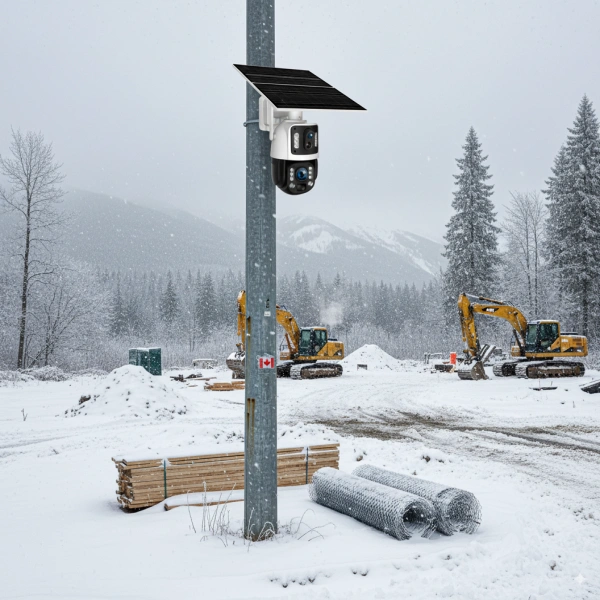
This level of precision is vital for orchard owners who don’t want to be woken up at 2 AM by a deer moving through the trees. When a human is detected, the SDL500 intelligently switches from its invisible infrared LEDs to high-intensity white floodlights. This serves two purposes: it captures full-color forensic evidence of the intruder and acts as a powerful visual deterrent to scare them off before they can cause damage.
Comparison Table: Traditional vs. SDL500 Solar 4G Cameras
To understand the business value for distributors and wholesalers, we must compare the SDL500 against the traditional solutions currently found on many Ontario farms.
| Feature | Traditional Wired CCTV | Standard Battery Wi-Fi Cam | SDL500 Solar 4G Camera |
|---|---|---|---|
| Installation Cost | High (Trenching/Wiring) | Medium (Wi-Fi Extenders) | Low (Plug-and-Play) |
| Power Source | Grid Power Only | Internal Battery (Manual Charge) | Continuous Solar + BMS |
| Detection Accuracy | Pixel Motion (Many False Alarms) | Basic PIR | AI Humanoid + PIR Dual Detection |
| Connectivity | Hardwired Ethernet | Wi-Fi (Limited Range) | 4G LTE (Global Coverage) |
| Night Vision | B&W Infrared | Low-power IR | Smart Dual-Light (Full Color) |
Smart Dual-Light Technology: Night Vision Reimagined
Night vision is where the SDL500 truly outperforms the competition. In the vast darkness of a rural orchard, standard infrared cameras produce “flat” black-and-white images that often blur facial features or license plates. Our detailed night vision analysis explains why this matters: if you cannot identify the person, the footage is useless for law enforcement.
The SDL500 utilizes Starlight-grade image sensors. In low-light conditions, it can still render color without the floodlights. Once the AI detects movement, the dual-light system engages. For an orchard owner, this means the difference between seeing a “blurry gray figure” and seeing “a suspect in a red jacket driving a blue pickup truck.” For B2B sellers, this is a major selling point for high-end floodlight solar security cameras.
Furthermore, the SDL500 supports two-way audio. If an intruder is detected, the owner can shout a warning through the camera’s built-in 100dB speaker directly from their smartphone. This proactive approach to security is far more effective than simply recording a crime in progress. It turns the camera from a passive observer into an active digital security guard.
Case Study: Protecting a 50-Acre Vineyard in Niagara
Problem: A boutique winery in Ontario’s Niagara region was suffering from repeat thefts of expensive irrigation equipment and specialized harvesting tools during the off-season. Because the storage sheds were located 800 meters from the main facility, Wi-Fi was non-existent and the cost to run power was quoted at $12,000.
Solution: The winery installed four SDL500 units—one at the main gate and three at the remote storage areas. We recommended the S10-4G PTZ model for the gate to provide 360-degree coverage and the fixed SDL500 for the sheds. These were integrated with local 4G SIM cards, providing a direct link to the manager’s phone.
Result: Within the first month, the system detected two unauthorized vehicles entering the property at night. The smart floodlights activated, capturing clear license plate data, and the manager used the two-way talk feature to inform the intruders that the police had been called. The intruders fled immediately. The winery saved an estimated $12,000 in infrastructure costs and has had zero equipment losses since the installation.
Troubleshooting Common Issues in Remote Solar Deployments
Even the best technology requires proper implementation. Based on 13 years of engineering experience, here are the most common issues we see with solar cameras in high-latitude regions like Ontario and how to solve them.
- Issue: Low Battery in Winter.
Solution: Ensure the solar panel is tilted at a 45-60 degree angle to catch the low winter sun and prevent snow buildup. Always use cameras with specialized low-power battery management.
- Issue: Signal Dropping.
Solution: Use a high-gain external 4G antenna if the orchard is in a valley. Check local carrier maps (Bell, Rogers, Telus) to choose the SIM card with the strongest local tower.
- Issue: Frequent False Alarms from Wind.
Solution: Adjust the PIR sensitivity in the UBox app to “Medium” or “Low” and enable “Humanoid Detection Only” to filter out moving tree branches.
- Issue: Lens Fogging.
Solution: Our SDL500 units are IP66-rated with vacuum-sealed housings to prevent internal condensation during rapid Ontario temperature shifts.
Selection Guide: Choosing the Right Solar Camera for Large-Scale Agriculture
If you are a distributor or an engineering contractor looking to source long-range solar security cameras, use this checklist to ensure the product meets the demands of an Ontario orchard:
- Battery Chemistry: Does it use LiFePO4 or specialized NCM cells designed for cold-weather performance?
- Solar Wattage: Is the panel at least 5W-10W? Lower wattage panels will fail to keep the camera charged during Ontario’s cloudy November and December.
- AI Integration: Does it have local AI processing for humanoid detection to save bandwidth and battery?
- App Stability: Is the interface (like the UBox platform) reliable for multi-user access so both the farm owner and security staff can monitor?
- Customization: Can the manufacturer provide custom mounting solutions for poles or tree trunks?
Market Trends and the Future of Agricultural Security
The demand for off-grid security is exploding. As 4G and 5G networks expand into rural Ontario, the barrier to entry for smart farming is disappearing. We are seeing a shift toward “Security on Demand”—systems that can be easily moved from a grape vineyard in the summer to a storage barn in the winter. Our rapid-deployment 4G cameras are leading this trend.
Furthermore, the integration of GPS is becoming standard for high-value agricultural assets. By choosing a hunting or security camera with GPS, orchard owners can track the location of the camera itself if it is stolen—a common issue in remote areas.
Summary: Why the SDL500 is the Gold Standard for Ontario Orchards
- Zero Infrastructure: No power or Wi-Fi required, saving thousands in installation costs.
- Intelligent Prevention: Dual-detection and smart lights stop crime before it happens.
- Built for Canada: Engineered to handle the thermal and light challenges of Ontario’s climate.
- B2B Ready: Competitive pricing and high reliability for wholesalers and contractors.
For orchard owners in Ontario, the SDL500 isn’t just a camera; it’s an insurance policy. For our B2B partners, it’s a high-margin, low-maintenance product that solves one of the most difficult challenges in the security industry. Explore our full range of wireless outdoor security cameras to find the perfect fit for your next project.