
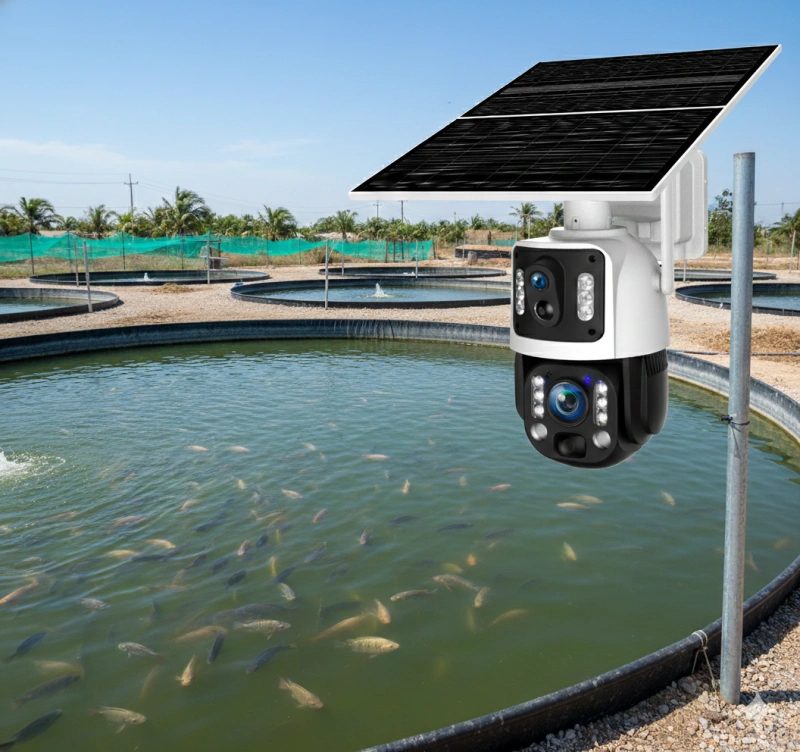
24/7 Monitoring for Aquaculture: The Essential “Electronic Eyes” for High-Value Aquatic Farms
Aquaculture represents one of the most challenging environments for security and surveillance. High-value aquatic products, such as shrimp, abalone, crab, and premium fish, are often raised in remote locations—coastal waters, inland lakes, or expansive ponds—where traditional infrastructure like power lines and wired internet are non-existent. For farm owners, the risks are multi-fold: theft during the harvest season, water quality emergencies, and the high cost of manual patrolling.
As an engineer with 13 years of experience in solar security camera design, I have seen how the transition from traditional wired CCTV to 4G solar-powered systems has revolutionized remote monitoring. For B2B buyers—whether you are a wholesaler supplying local farmers or a contractor designing an off-grid surveillance network—understanding the technical nuances of these “electronic eyes” is critical to ensuring long-term reliability in harsh, humid environments.
The Critical Pain Points of Aquaculture Security
Aquaculture operators face unique challenges that standard home security cameras cannot address. First, there is the geographical hurdle. Most high-value farms are located far from urban grids, making the cost of trenching and cabling for power and Ethernet prohibitive. Second, the environment is highly corrosive. Salt spray and high humidity can degrade inferior camera housings within months.
Furthermore, theft often occurs at night in areas with zero ambient light. Without advanced night vision capabilities, a security camera becomes useless after sunset. Finally, there is the need for real-time alerts. In aquaculture, a few hours of delay in identifying a problem—whether an intruder or a failure in aeration equipment—can result in the loss of an entire season’s profit. This is why the eyes of smart agriculture must be self-sufficient and connected via 4G LTE.
Technical Deep Dive: Why 4G Solar Cameras are the Perfect Fit
The core technology that makes aquaculture monitoring viable today is the integration of low-power chipsets and high-efficiency solar energy systems. A low power camera is designed to remain in a “sleep” state, consuming micro-amps of current until a PIR (Passive Infrared) sensor or radar detects motion. This allows the system to operate indefinitely on a small solar panel and battery bank.
For aquaculture, we specifically recommend 4G-enabled units. Unlike WiFi, which has a limited range, 4G cameras provide global connectivity wherever there is a cellular signal. This makes them ideal for large-scale pond setups or floating cages in the middle of a bay. By utilizing a 4G security camera, owners can access live feeds from their smartphones even if they are hundreds of miles away from the farm.
Comparative Analysis: Traditional CCTV vs. 4G Solar Systems
When advising clients on equipment selection, it is important to demonstrate the ROI (Return on Investment) of modern solar solutions. The following table highlights the differences in deployment and maintenance for aquaculture sites.
| Feature | Traditional Wired CCTV | 4G Solar-Powered Cameras |
|---|---|---|
| Installation Cost | High (Trenching, cabling, power supply) | Low (Mount-and-play, no cabling needed) |
| Connectivity | Ethernet/Fiber (Expensive for remote sites) | 4G LTE (Seamless coverage in remote areas) |
| Power Supply | Grid-dependent (Prone to outages) | Self-sustaining Solar + Lithium Battery |
| Flexibility | Fixed location; hard to move | Rapidly deployable and easy to relocate |
| Environmental Resistance | Standard IP66 (Vulnerable to salt spray) | IP67 with specialized anti-corrosion coating |
Maximizing Reliability: The Importance of BMS and Battery Technology
In the field, the battery is often the first point of failure. In aquaculture zones, where temperatures can fluctuate and humidity is high, the battery management system (BMS) is the “brain” that ensures the camera survives. Our engineering team prioritizes BMS technology to prevent overcharging, over-discharging, and short circuits, particularly when using high-density Lithium Iron Phosphate (LiFePO4) batteries.
LiFePO4 batteries are superior for aquaculture because they can withstand more charge cycles and are more stable in high-temperature coastal environments. When paired with a battery powered security camera design, these systems provide the resilience needed for 24/7 surveillance through rainy seasons or consecutive cloudy days.
Optimizing Night Vision for Open Water Environments
Monitoring a fish pond at night is vastly different from monitoring a driveway. Water reflects light, which can blind standard infrared (IR) sensors. To combat this, we utilize Smart Dual-Light technology. This system uses IR for covert monitoring but switches to high-intensity white light floodlights when motion is detected. Not only does this provide full-color video for identification, but it also acts as a powerful deterrent for poachers.
For clients who require even more detail, our floodlight dual-lens solar security cameras offer wide-angle views paired with a telephoto lens, allowing users to zoom in on a boat’s registration number or an intruder’s face without losing the peripheral context of the entire pond. This level of detail is critical for providing evidence to law enforcement.
Case Study: Securing a High-Value Shrimp Farm in Southeast Asia
Problem: A large-scale shrimp farm was losing 15% of its harvest to nighttime theft. The farm covered 20 hectares with no power lines, and traditional security guards were unable to monitor the entire perimeter effectively.
Solution: The farm deployed 12 units of our S10 4G mini solar PTZ cameras strategically along the perimeter and near the aeration equipment. These cameras utilized 4G connectivity to send real-time alerts to the owner’s phone when motion was detected after 10:00 PM.
Result: Within the first month, the system detected and deterred three attempted thefts. The high-intensity siren and light alarm, combined with the siren flash light alarm feature, scared off intruders before they could cast nets. The farm reported a 90% reduction in theft-related losses, paying for the entire system in just one harvest cycle.
Troubleshooting Common Issues in Aquaculture Surveillance
- Q: Why is my camera losing connection during heavy rain?A: 4G signals can be attenuated by heavy rainfall (rain fade). Ensure your camera is equipped with a high-gain external antenna and that you are using a carrier with strong local coverage.
- Q: How do I prevent salt spray from damaging the lens?A: Use cameras with specialized glass coatings that repel water and salt. Periodic cleaning with fresh water and a soft cloth is recommended for systems installed directly on the coastline.
- Q: The battery dies after three days of rain. What is wrong?A: This usually indicates a mismatch between the solar panel wattage and the camera’s power consumption. For aquaculture, we recommend a long range solar security camera with a 5W to 10W panel to ensure a positive charge balance even in low-light conditions.
Selection Checklist for Aquaculture Security Cameras
When sourcing wireless outdoor security cameras for aquatic environments, use this checklist to ensure you are getting professional-grade equipment:
- Ingress Protection: Minimum IP66, preferably IP67 for coastal use.
- Connectivity: 4G LTE with support for local frequency bands (B1/B3/B5/B7/B8/B20 etc.).
- Night Vision: Dual-light source (IR + White Light) with at least 30 meters of range.
- Power Management: Built-in BMS with LiFePO4 battery support.
- Storage: Support for both local SD card (up to 128GB) and encrypted cloud storage.
- AI Features: Humanoid detection to reduce false alarms from birds or moving water.
Market Trends: The Shift Toward Smart Off-Grid Monitoring
The aquaculture industry is moving toward “Smart Farming.” This involves more than just security; it involves environmental monitoring. We are seeing increased demand for integrated solutions where 4G cameras also act as hubs for water quality sensors (pH, dissolved oxygen). While we specialize in the video aspect, our environmental monitoring solutions provide the structural backbone for these advanced deployments.
Furthermore, the 2025 market outlook suggests a surge in demand for solar security cameras as global energy costs rise and the cost of 4G data continues to fall. For wholesalers and retailers, adding a specialized “Aquaculture Series” to your portfolio is a strategic move to capture a high-margin, professional-grade market segment.
Summary: Investing in Long-Term Protection
For aquaculture operators, a 4G solar camera is not just a security device; it is a vital tool for operational efficiency and peace of mind. By choosing the right technical specifications—robust BMS, high-gain 4G antennas, and dual-light night vision—you can provide a 24/7 “electronic eye” that survives the harshest conditions.
As a factory dedicated to B2B engineering and production, we focus on providing the customization and technical depth required for these specialized applications. Whether you are looking for a battery powered security camera supplier for a large project or a brand owner needing a reliable OEM partner, our 13 years of expertise ensure your products will perform in the field. Explore our full range of wireless outdoor security cameras today to secure your next project.