
Need to See a Face from 3000 Feet? The SDL500 Solar Camera’s 36x Optical Zoom Delivers.
In the security industry, the most critical moments are often lost to distance. A security event occurs at the edge of a property, and the recorded footage shows a blurry, unidentifiable figure. This is a common and costly failure point for businesses relying on standard surveillance, turning expensive security investments into useless data. For operators managing large areas—construction sites, farms, infrastructure, or large commercial lots—the inability to capture actionable details like faces or license plates from afar is not just an inconvenience; it’s a significant security vulnerability.
Standard security cameras are designed for general observation, not for forensic identification at long ranges. They rely on wide-angle lenses or, worse, “digital zoom,” which merely enlarges pixels and degrades image quality. The result is footage that confirms an event happened but fails to provide the evidence needed to act. This gap in capability is precisely where specialized technology becomes essential.
The Physics of Sight: Why Optical Zoom is Non-Negotiable for Long-Range Surveillance
To understand the challenge of long-range identification, it’s crucial to distinguish between two fundamentally different technologies: optical zoom and digital zoom. Many camera manufacturers blur this line in their marketing, but for a professional application, the difference is night and day. As engineers, we focus on the physics of light and lenses, which is the foundation of true surveillance capability.
Optical zoom uses a physical assembly of lenses that move to change the focal length. Think of it like a professional DSLR camera lens or a pair of binoculars. As you zoom in, the lenses adjust to magnify the light from a distant object, projecting a larger, clearer image onto the camera’s sensor without sacrificing resolution. Every pixel you capture contains real, undiluted information from the scene.
Digital zoom, on the other hand, is not a zoom function at all. It is simply an in-camera cropping and enlargement of the image already captured by the sensor. It takes a section of the picture and blows it up, effectively guessing what the missing pixels should be. This process inevitably leads to a blurry, pixelated image that lacks the detail required for identification. It provides a closer view, but not a more detailed one.
Optical vs. Digital Zoom: A Head-to-Head Comparison for Professionals
For B2B clients—be it distributors equipping installers or brand owners defining their product specs—understanding this distinction is key to delivering real value. A camera that relies on digital zoom for long-range tasks is destined to disappoint the end-user. Here is a clear breakdown of why optical zoom is the only viable solution for serious surveillance.
| Feature | 36x Optical Zoom (e.g., UBOXCAM SDL500) | Digital Zoom |
|---|---|---|
| Image Quality at Max Zoom | Excellent. Maintains full sensor resolution (e.g., 4MP/8MP) for sharp, clear images. | Poor. Significant degradation, pixelation, and blurriness. |
| Detail Retention | Captures fine details like facial features, text on clothing, and license plate characters. | Loses all fine details, rendering them into indistinct shapes. |
| Effective Identification Range | Up to 3000 feet (approx. 900 meters) or more, depending on conditions. | Typically less than 100 feet for reliable identification. |
| Suitability for Evidence | High. Provides legally admissible, clear evidence for law enforcement. | Low. Often inadmissible or useless for positive identification. |
| Technology Principle | Physical lens movement to magnify light. | Software-based image cropping and enlargement. |
Introducing the UBOXCAM SDL500: Engineering for Extreme Distances
The UBOXCAM SDL500 is the culmination of over a decade of engineering experience in solar-powered surveillance. It was designed specifically to solve the long-range identification problem. The heart of this camera is its precision-engineered 36x optical zoom lens module. This isn’t an off-the-shelf component; it’s a system built for the unique demands of an autonomous, solar-powered PTZ (Pan-Tilt-Zoom) camera.
Achieving this level of performance in an off-grid device presented several engineering challenges we had to overcome:
- Power Management: The motors driving a 36x zoom lens and a PTZ mechanism require bursts of power. Our advanced Battery Management System (BMS) is designed to deliver this power reliably while maintaining ultra-low standby consumption, ensuring the camera operates 24/7 on solar power alone.
- Image Stabilization: At 36x magnification, the slightest vibration from wind or pole sway can render an image unusable. The SDL500 integrates robust Electronic Image Stabilization (EIS) algorithms that counteract this movement, delivering a steady, clear picture even at maximum zoom.
- Autofocus Precision: Focusing accurately on a target half a mile away is complex. We employ a hybrid autofocus system that combines laser-assisted distance measurement with rapid contrast detection, allowing the camera to snap into sharp focus instantly, whether tracking a vehicle or a person.
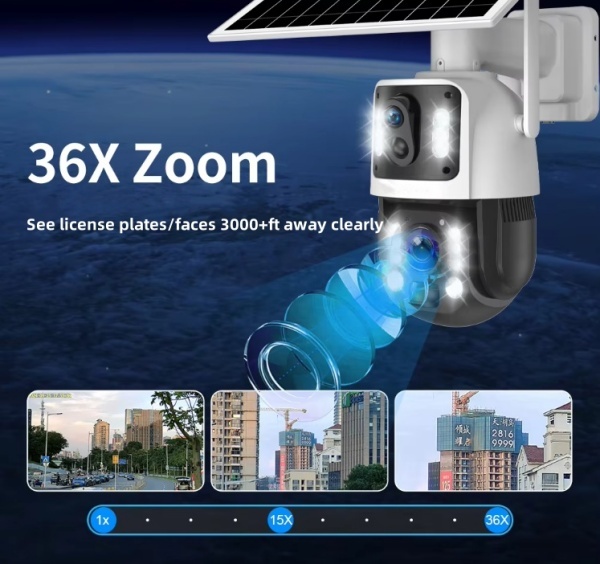
These integrated systems ensure that the SDL500’s powerful zoom is not just a specification on a datasheet, but a reliable, field-tested tool for professional security. For our partners, this means providing a long-range solar security camera that actually works as advertised.
Application Case Study: Securing a 500-Acre Farm
- Problem: The owner of a large agricultural operation was facing persistent issues with equipment theft and trespassing along a remote perimeter fence nearly a mile long. His existing wide-angle cameras could show that a vehicle had entered but provided no usable details for identification. Installing a network of cameras along the entire fence line was prohibitively expensive and difficult to maintain.
- Solution: We recommended the deployment of a single UBOXCAM SDL500 4G Solar PTZ Camera on a centrally located 30-foot pole. From this one vantage point, the operator could use the PTZ function to scan the entire perimeter. The camera’s auto-tracking feature was configured to lock onto and follow any moving vehicle or person detected in designated zones.
- Result: Within the first month of operation, the SDL500 automatically tracked a suspicious truck near a distant gate. The operator, viewing remotely on his phone, zoomed in and captured a crystal-clear 4K image of the truck’s license plate from an independently verified distance of over 2,800 feet. The footage also provided a clear facial image of the driver. This evidence was handed to law enforcement, leading to the recovery of stolen property and a successful prosecution. The client solved his security problem with one camera, saving an estimated $20,000 in hardware and installation costs compared to a multi-camera solution.
Troubleshooting & Best Practices for High-Zoom Deployment
Deploying a high-zoom camera effectively requires more than just mounting it on a pole. As a manufacturer, we provide our partners with the technical guidance needed for success. Here are some key considerations:
- Installation Stability is Paramount: A 36x zoom camera will magnify any instability in its mount. Always use a rigid, deep-set steel pole and professional-grade mounting brackets. Avoid mounting on buildings with high vibration or flexible light poles.
- Optimize Power for Patrols: If the camera will be used for frequent PTZ patrols and zooming, it may require a larger solar panel and battery configuration. We work with our B2B partners to customize power solutions based on the end-user’s specific operational needs and local sunlight conditions, a key benefit of working directly with a battery-powered security camera manufacturer.
- Understand Environmental Factors: Extreme long-range viewing can be affected by atmospheric conditions like heat haze or fog. While our cameras feature image processing to mitigate some of these effects, it’s important to set realistic expectations with clients about performance in adverse weather.
- Leverage Presets and Tours: For monitoring large areas, manually controlling the camera 24/7 is impractical. Instruct users to set up preset positions for critical locations (gates, building entrances, fuel tanks) and automated tours that cycle between these points. This ensures consistent coverage without constant manual input.
The Business Advantage for Our Partners
For distributors, installers, brand owners, and security entrepreneurs, the SDL500 isn’t just another camera—it’s a problem-solver that opens up new markets and high-value projects. Standard cameras have commoditized the market for small-scale security. The future of growth lies in specialized solutions for challenging environments.
By adding a true 36x optical zoom solar camera to your portfolio, you can:
- Target High-Value Clients: Approach markets that were previously difficult to serve, including agriculture, critical infrastructure (dams, energy stations), large logistics yards, and sprawling commercial properties.
- Deliver Superior Results: Provide a solution that offers undeniable, evidence-grade video quality where competitors’ products fail. This builds a reputation for expertise and reliability.
- Increase Profit Margins: Specialized, high-performance products command higher prices and better margins than standard, off-the-shelf cameras.
- Benefit from OEM/ODM Customization: As a factory, we offer our partners the ability to customize features, branding, and software to create a unique product for their market.
Stop letting distance be the weak link in your security offerings. The technology to see a face or license plate from 3000 feet away, powered entirely by the sun, is here. Ready to provide your clients with unmatched long-range surveillance? Contact the UBOXCAM engineering team today to get a quote and discuss how our customizable solar security solutions can elevate your business.