
Still Worried About Remote Area Monitoring? The SDL500 4G Solar Camera Covers Ultra-Long Distances!
As an engineer with over a decade in the field, I’ve seen countless projects stall due to one simple, recurring obstacle: distance. For farms, construction sites, rural estates, and critical infrastructure, the lack of power and Wi-Fi creates frustrating security blind spots. Running cables over hundreds or thousands of feet is not just expensive; it’s often impossible. This is the exact challenge we designed the UBOXCAM SDL500 4G Solar Camera to solve.
Traditional security solutions were built for urban environments with readily available infrastructure. But what about the valuable assets located miles from the nearest outlet or router? This gap in the market represents a significant pain point for end-users and a massive opportunity for our B2B partners, including distributors, installers, and 4G operators. The demand for a truly independent, long-range security camera is higher than ever.
This article will break down the technical advantages that enable genuine long-range monitoring, compare it to legacy systems, and provide a clear roadmap for deploying a reliable off-grid security network. We’ll move beyond marketing claims and into the engineering specifics that deliver real-world performance.
The Technology Behind True Long-Range Surveillance
The term “long-range” is often misused. A standard Wi-Fi camera might claim a range of 300 feet in perfect, open-air conditions, but walls, trees, and interference can reduce that to less than 50 feet. True long-range capability isn’t about Wi-Fi; it’s about leveraging the vast, existing cellular network. This is where a 4G solar camera excels.
The core components enabling this are:
- High-Gain 4G Antennas: Unlike the tiny internal antennas in many devices, our cameras utilize high-gain external antennas. Measured in dBi (decibels relative to an isotropic radiator), a higher dBi rating means the antenna can capture weaker signals from cell towers miles away and transmit video data back with greater stability. This is crucial for consistent performance in remote or fringe coverage areas.
- Industrial-Grade 4G LTE Modules: We integrate modules that support a wide array of frequency bands (like B2, B4, B12 for North America and B1, B3, B7, B20 for Europe). This ensures broad compatibility with major carriers like AT&T, Verizon, T-Mobile, Vodafone, and Orange, allowing you to choose the best provider for any specific location.
- Optimized Power Management (BMS): Long-range transmission requires power. Our integrated Battery Management System (BMS) is the brain of the operation. It meticulously manages the flow of energy from the high-efficiency solar panel to the high-capacity lithium-ion battery, ensuring the camera has the power needed for stable 4G connectivity, day and night. Explore more about how BMS is the key technology for solar camera reliability.
Core Comparison: 4G Solar vs. Traditional Security Systems
For our partners—wholesalers, installers, and brand owners—understanding the value proposition is key to communicating it to your clients. The advantages of a 4G solar camera become crystal clear when compared directly to older technologies.
| Feature | SDL500 4G Solar Camera | Traditional Wired System | Standard Wi-Fi Camera |
|---|---|---|---|
| Effective Range | Virtually unlimited (anywhere with 4G signal) | Limited by cable length (costly beyond 300 ft) | Typically under 300 ft, easily obstructed |
| Power Source | Integrated Solar Panel & Battery | Requires dedicated 110V/220V AC power | Requires AC power outlet |
| Installation Cost | Low (No trenching or wiring) | Very High (Trenching, conduit, labor) | Moderate (Requires nearby power) |
| Deployment Speed | Rapid (Under 1 hour per camera) | Slow (Days or weeks) | Fast (If power and Wi-Fi are present) |
| Location Flexibility | Extremely High (Mount on poles, trees, buildings) | Very Low (Tied to power/data lines) | Low (Tied to Wi-Fi router range) |
Case Study: Securing a 500-Acre Vineyard
To illustrate the real-world impact, let’s look at a project we consulted on for a large vineyard operator in a remote valley.
Problem: The vineyard faced persistent issues with equipment theft from a remote storage barn and unauthorized vehicle access via a dirt service road, both over a mile from the main office. There was no power or Wi-Fi in these areas. The estimated annual loss from theft and vandalism was over $30,000. Trenching power and data cables was quoted at an astronomical $75,000.
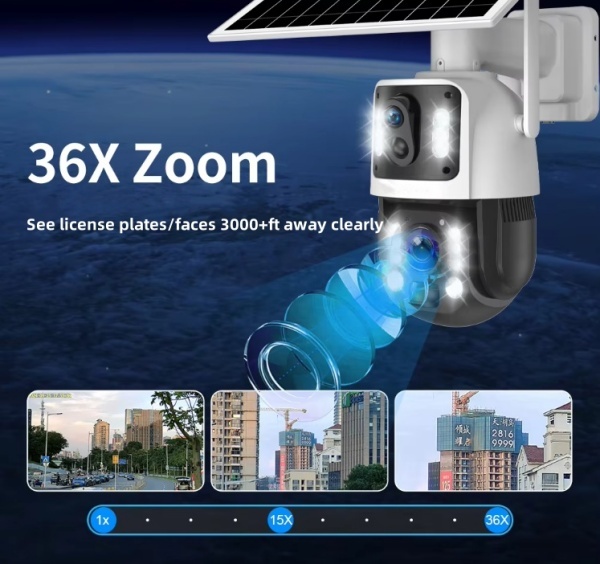
Solution: We recommended the deployment of three SDL500 4G Solar Cameras. One was mounted on a pole overlooking the service road entrance, and two were positioned to cover the storage barn and surrounding equipment yard. Using a data plan from a national carrier with known coverage in the region, the entire system was installed and operational in a single afternoon by two technicians.
Result: Within the first three months, the system captured clear footage of an unauthorized vehicle entering at night, leading to the recovery of stolen property. The client reported an 85% reduction in security incidents. The total project cost was under $5,000—a 93% saving compared to the wired quote. This project not only secured the property but also provided a substantial and immediate return on investment, cementing the value of our long-range solar security camera solutions for the installer who sold the package.
Troubleshooting Common Long-Range Deployment Challenges
Even with the best technology, remote deployments can have challenges. Here are answers to common questions we receive from our installation partners.
Q: What if the 4G signal is weak in the exact spot I need to monitor?
A: This is a common issue. First, use a cell signal meter or an app to find the spot with the strongest signal nearby, even if it’s 20-30 feet away. Our cameras can be mounted there, as their field of view can still cover the target area. Additionally, we offer optional high-gain directional antennas that can be aimed at the nearest cell tower to significantly boost signal reception.
Q: How much data does a long-range 4G camera use, and how do I manage costs?
A: Data usage depends entirely on activity. For a camera in a low-traffic area relying on motion-triggered recording, usage can be as low as 1-2 GB per month. For active construction sites, it might be 10-20 GB. Our cameras feature intelligent event detection (PIR + AI analysis) to minimize false alerts from wind or animals, drastically reducing unnecessary data consumption and uploads.
Q: Will the camera work through a long, cloudy winter?
A: This is a critical engineering consideration. We design our systems by calculating the power budget. The SDL500’s combination of a high-efficiency solar panel and a large-capacity battery is designed to provide up to 7-10 days of autonomy without any direct sunlight. For locations with extreme winters, like in Canada or Northern Germany, we offer larger, bolt-on solar panel kits to ensure year-round operation.
A Practical Guide for Selecting Your Solution
For distributors, Amazon sellers, and entrepreneurs entering this market, guiding your customers to the right solution is paramount. Use this checklist to qualify projects and ensure success:
- Verify 4G Coverage: Before anything else, use online carrier maps (e.g., Verizon, AT&T, Vodafone) or a signal meter to confirm at least a basic 4G signal exists at the deployment site.
- Assess the Environment: Is the camera facing direct sunlight most of the day? Are there heavy foliage or large buildings that could obstruct the signal to the cell tower?
- Define the Security Goal: Does the client need a wide overview (wide-angle lens) or to identify faces and license plates at a distance (varifocal or PTZ lens)? This determines the camera model.
- Calculate the Data Plan: Help the customer choose a suitable M2M/IoT data plan. Advise starting with a smaller plan and upgrading if necessary based on real-world usage.
By empowering your clients with this knowledge, you transition from being a product seller to a trusted solution provider. This expertise is what builds brand loyalty and a reputation for reliability.
For B2B partners seeking to capitalize on the growing demand for off-grid security, the SDL500 and similar 4G solar cameras offer a powerful, field-tested solution. It directly addresses the critical market need for monitoring remote and expansive properties without the exorbitant cost and complexity of traditional systems. To discuss custom branding (OEM/ODM), volume pricing, or the technical specifications for your next big project, **reach out to our UBOXCAM engineering and sales team today**.