
Reliable Security in the Rain: How the SDL500 High-Capacity Battery Solves Monitoring Downtime
For security contractors and project managers, the arrival of the rainy season often brings a recurring nightmare: offline cameras. Traditional solar-powered systems frequently fail during consecutive days of heavy overcast or rain, leaving critical sites like construction zones and remote farms vulnerable. When the battery dies, the security perimeter vanishes, leading to potential theft, safety violations, and costly site visits to manually recharge units.
The core issue isn’t just a lack of sunlight; it is often a combination of undersized battery storage and inefficient energy management. As an engineer with over 13 years in the solar security industry, I have seen how “standard” 10,000mAh batteries fail to meet the demands of professional-grade 24/7 monitoring. This is where the SDL500 series, featuring high-capacity battery technology, changes the game for the B2B market.
In this guide, we will analyze the technical barriers of rainy-season monitoring and explore how advanced battery management systems (BMS) and high-density storage ensure your wireless outdoor security cameras stay online even when the sun disappears for weeks.
Why Standard Solar Cameras Fail During the Rainy Season
Most consumer-grade solar cameras are designed for “ideal” conditions—bright, direct sunlight for at least 4-6 hours a day. However, in regions like the UK, Germany, or the Pacific Northwest, “ideal” is a luxury. During the rainy season, solar panel efficiency can drop by 80-90%. If the camera’s power consumption exceeds the trickle charge provided by ambient light, the battery will eventually hit its low-voltage cutoff.
Furthermore, standard lithium batteries often lack a sophisticated BMS (Battery Management System). Without intelligent power distribution, the camera may continue to use high-energy features like full-color night vision or continuous recording until the battery is completely exhausted. This deep discharge shortens the battery life and makes it harder for the system to “wake up” once the sun returns.
For B2B clients, especially construction site security installers, this downtime is unacceptable. The cost of labor to replace a battery or reboot a camera mounted 5 meters high far exceeds the initial cost of a higher-quality system.
The SDL500 Solution: Engineering for Continuous Operation
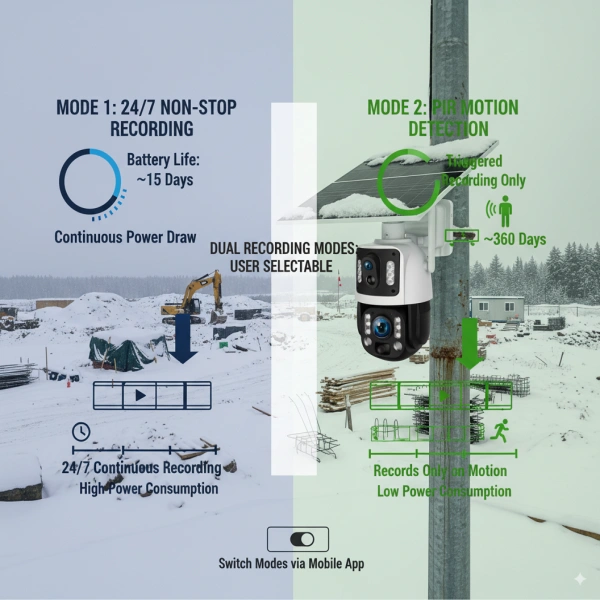
The SDL500 was engineered with a “Worst-Case Scenario” philosophy. Instead of designing for sunny days, we designed for 15 days of continuous darkness. By integrating ultra-high-capacity lithium-ion cells with an intelligent low-power chipset, the SDL500 provides a buffer that standard cameras simply cannot match.
Key to this performance is the Smart Dual-Light technology. Instead of keeping power-hungry white lights on all night, the system uses high-efficiency infrared for standby and only triggers the floodlights when human motion is detected. This surgical use of energy preserves the battery-powered security camera’s longevity without compromising evidence quality.
Core Comparison: Standard Solar Camera vs. SDL500 Series
To understand the commercial value of the SDL500, let’s look at the technical specifications compared to a typical market-entry solar camera.
| Feature | Standard Solar Camera | SDL500 High-Capacity Series |
|---|---|---|
| Battery Capacity | 8,000 – 12,000 mAh | 30,000 – 50,000 mAh (Project Dependent) |
| Standby Time (Rainy Days) | 3 – 5 Days | 15 – 25 Days |
| BMS Protection | Basic Overcharge/Discharge | Advanced BMS with Low-Temp Protection & Power Path Management |
| Night Vision Logic | Always Infrared or Always White Light | Smart Dual-Light (IR to Full Color on Motion) |
| Connectivity Reliability | Standard 4G/WiFi | Signal-Boosted 4G with Auto-Reconnection Logic |
Deep Dive: The Role of BMS in Rainy Weather Reliability
A common misconception is that a bigger battery is the only solution. While capacity is vital, the Battery Management System (BMS) is the “brain” that ensures that capacity is used wisely. In the SDL500, the BMS performs several critical functions that are essential for building site security cameras:
- Power Path Management: The system can simultaneously charge the battery and power the camera, optimizing the small amount of current generated during cloudy days.
- Low-Power Hibernation: When the battery drops below 20%, the camera enters a “Super-Econ” mode, prioritizing PIR (Passive Infrared) triggers over continuous heartbeat signals to the server.
- Temperature Compensation: Rainy seasons are often cold. The SDL500 BMS adjusts charging voltage based on ambient temperature to prevent lithium plating, extending the battery lifespan to over 5 years.
This engineering depth is why many of our partners who supply long-range solar security cameras have transitioned to the SDL500 platform. It reduces “RMA” (Return Merchandise Authorization) rates and boosts customer trust.
Application Case Study: Off-Grid Construction Security
Problem: A construction firm in Vancouver, Canada, experienced 30% camera downtime during the winter months due to heavy rain and low light. Their existing 4G cameras were frequently going offline, requiring technicians to swap batteries manually—a process costing $200 per visit.
Solution: The firm replaced 50 units with our SDL500 4G Solar PTZ cameras. We customized the firmware to prioritize human detection and utilized the low-power camera technology to minimize idle draw.
Result: Over a 90-day period with 60 days of recorded precipitation, the SDL500 units maintained 100% uptime. The firm saved an estimated $6,000 in maintenance labor costs and ensured continuous monitoring of high-value equipment. For more on this, see our resource on why 4G solar cameras are the ultimate solution for construction sites.
Selection Guide: What to Look for in a Rainy-Season Solar Camera
When sourcing for your inventory or project, use this checklist to ensure the product can actually handle real-world weather challenges:
- Check the Milliampere-Hours (mAh): For professional use, look for at least 20,000mAh. Anything less is likely for residential use only.
- Solar Panel Wattage: A high-capacity battery needs a powerful “hose” to fill it. Ensure the panel is at least 6W to 10W (monocrystalline).
- PIR Sensor Quality: The camera should only wake up for real threats. High-quality PIR prevents false triggers from wind or rain, saving battery.
- Waterproofing Grade: Ensure an IP66 or IP67 rating. Rain isn’t just a power problem; it’s a moisture ingress problem.
- 4G Signal Strength: In heavy rain, wireless signals can degrade. The SDL500 uses high-gain antennas to maintain the link to the 4G network.
Troubleshooting Common Rainy Day Issues
If you are currently experiencing issues with solar camera downtime, here are a few expert tips from our production line:
- Angle the Panel Correctly: Even without direct sun, an angled panel (30-45 degrees depending on latitude) catches more ambient light and allows rain to wash away dust/debris that blocks UV rays.
- Check for “Ghost Triggers”: Heavy rain hitting a PIR sensor can sometimes cause false wake-ups. Adjust sensitivity in the UBox app to “Medium” or “Low” during storms.
- Firmware Updates: Ensure your cameras are running the latest power-optimization firmware. At UBOXCAM, we constantly refine our low-power algorithms to improve solar-powered camera performance.
The Future of Off-Grid Monitoring
As we look toward 2025, the demand for “zero-maintenance” security is growing. Technologies like AI-based power management and dual-lens systems (such as our floodlight dual-lens solar camera) are becoming the new standard. The SDL500 represents the pinnacle of current battery technology, providing a bridge between high-performance monitoring and environmental constraints.
Whether you are a wholesaler looking for a reliable product line or a contractor securing a multi-million dollar asset, the battery capacity and BMS quality should be your top priorities. Don’t let a rainy season damage your reputation or your bottom line.
Key Takeaways for B2B Buyers
- Reliability is Profit: Every hour of downtime is a risk to the end-user and a cost to the installer. High-capacity batteries like the SDL500 eliminate these costs.
- Technical Superiority: Focus on the BMS and low-power chipsets, not just the solar panel size.
- Versatility: High-capacity systems are ideal for everything from smart agriculture to critical infrastructure protection.
If you are ready to upgrade your security offerings or need a customized solar solution for a challenging environment, contact our engineering team today. We provide OEM/ODM services tailored to your specific regional weather patterns and project requirements.