
Why Professional Installers Recommend the SDL500: Stability & Durability = Increased Customer Satisfaction!
As a professional security installer, your reputation is your most valuable asset. It’s built on trust, reliability, and the quality of your work. But what happens when the hardware you install fails? Every truck roll to fix a faulty camera, every frustrated client call about downtime, and every system that dies in a cold snap chips away at that reputation. It costs you time, money, and, most importantly, client confidence.
For over a decade, I’ve been on the factory floor, designing and overseeing the production of solar security cameras. I’ve seen firsthand what separates a camera that lasts six months from one that provides reliable service for years. The most common pain point for installers isn’t price; it’s the high cost of unreliability. That’s precisely why we engineered the SDL500. This isn’t just another camera; it’s a solution designed to end the cycle of service calls and build your reputation for dependable, long-lasting security solutions.
An Engineer’s Deep Dive: What Makes the SDL500 a Rock-Solid Choice
The terms “stable” and “durable” are overused in marketing. For an engineer, they represent specific design choices and component selections that directly impact performance. Let’s break down the core technologies that make the SDL500 the go-to choice for installers who can’t afford failures.
The Heart of Reliability: Our Advanced Battery Management System (BMS)
The single biggest point of failure in any solar-powered device is its battery system. Consumer-grade cameras often use rudimentary protection circuits, leaving them vulnerable to the elements. Our proprietary BMS is a sophisticated control center that actively manages battery health, extending its life and ensuring consistent operation. This is a critical piece of technology often overlooked, yet vital for a battery-powered security camera.
- Temperature Compensation: The BMS includes temperature sensors that adjust the charging current. It prevents charging in freezing conditions (below 0°C/32°F) which can permanently damage a lithium-ion battery, a common cause of failure in cheaper models.
- Cell Balancing: It ensures all individual battery cells are charged and discharged equally, preventing premature degradation of the battery pack and maximizing its lifespan to over 500 charge cycles.
- Comprehensive Protection: The system actively guards against over-voltage, under-voltage, short circuits, and over-current, essentially eliminating the most common electrical failure points.
More Than Just Light: Smart Dual-Light (SDL) for Performance and Efficiency
Poor night vision is a frequent client complaint. While many cameras offer infrared or white light, our Smart Dual-Light system is an intelligent hybrid. By default, it operates in a power-saving infrared mode for discreet monitoring. When the PIR sensor and AI algorithm detect a human shape, the bright white LED floodlights activate.
This intelligent approach delivers three key benefits for installers:
- Superior Evidence Quality: The floodlights provide full, vivid color video at the most critical moments, making it easier to identify subjects and details.
- Active Deterrence: The sudden illumination often startles and deters potential intruders before a crime occurs, which is a feature clients love.
- Optimized Power Consumption: By using the high-draw floodlights only when necessary, the SDL500 conserves significant battery life compared to cameras that stay in full-color mode all night, ensuring it survives long stretches of cloudy weather.
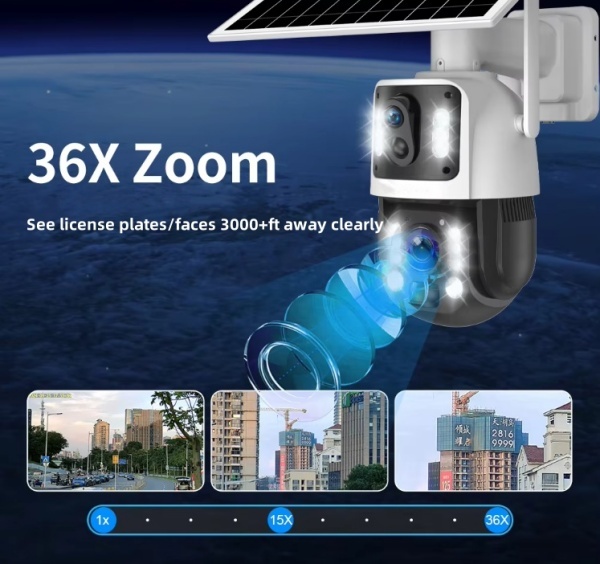
SDL500 vs. Standard Consumer Cameras: An Installer’s Comparison
When you present a quote to a client, they might see a cheaper camera on Amazon and ask why yours costs more. This table gives you the engineering-backed data to explain the true value and lower total cost of ownership of a professional-grade system.
| Feature / Specification | UBOXCAM SDL500 Professional Grade | Standard Consumer-Grade Camera |
|---|---|---|
| Battery Management System (BMS) | Advanced with temperature protection, cell balancing, and multi-layer safety protocols. | Basic overcharge/discharge protection only. No temperature control. |
| Housing Material & IP Rating | Die-cast aluminum alloy, IP66 rated for dust and high-pressure water jets. | ABS plastic, typically IP65 rated, prone to UV degradation and cracking. |
| Operating Temperature Range | -20°C to 60°C (-4°F to 140°F) with charging protection. | -10°C to 50°C (14°F to 122°F), often without safe charging logic. |
| AI False Alarm Reduction | Hardware-level PIR sensor + advanced AI human & vehicle detection algorithm. | Basic pixel-change detection, leading to high false alarms from rain, insects, and shadows. |
| Expected Lifespan / Service Calls | 3-5+ years. Designed to minimize service calls. | 1-2 years. Frequent service calls for battery and connectivity issues are common. |
| Technical Support | Direct access to manufacturer engineering support for professional installers. | Limited to end-user call centers with basic troubleshooting scripts. |
Case Study: Reducing Installer Callbacks by 95%
Don’t just take our word for it. Let’s look at a real-world scenario we tracked with one of our installation partners in the UK.
- Problem: An installer specializing in security for rural farms and construction sites was spending nearly 20% of his weekly hours on service calls for a popular consumer-grade 4G solar camera brand. The primary complaints were dead batteries during winter months and constant false alerts from wildlife, leading to dissatisfied clients.
- Solution: He switched his primary offering to the UBOXCAM SDL500 4G model. He deployed 50 units across eight different client sites over a three-month period.
- Result: In the first 12 months following the switch, his service calls related to camera hardware failure dropped from an average of 3-4 per week to just 3 in the entire year—a staggering 95% reduction. Client satisfaction soared, leading to two major referral contracts for securing new building sites. His profit margin on each job increased due to the elimination of unpaid follow-up visits.
Common Installer Questions & Engineering Answers
As an installer, you face the same issues repeatedly. Here’s how the SDL500 is specifically designed to solve them.
Q: “My client’s old solar camera dies every winter. How is the SDL500 different?”
A: This is a direct result of poor battery management. The SDL500’s BMS actively prevents charging below freezing, protecting the battery from irreversible damage. Furthermore, our high-efficiency monocrystalline solar panels are optimized for low-light conditions, maximizing power generation even on overcast winter days to keep the battery topped up.
Q: “False alarms from rain and insects are a nightmare for me and my clients. What does the SDL500 do?”
A: We use a dual-tech approach. A passive infrared (PIR) sensor first detects body heat, which immediately filters out non-living triggers like rain or swaying branches. That trigger is then analyzed by our onboard AI, which is specifically trained to recognize human and vehicle shapes. This combination reduces false alarms by over 90% compared to simple motion detection.
Q: “What about connectivity on remote sites where cell signal is weak?”
A: The 4G version of the SDL500 uses an industrial-grade cellular module and is equipped with a high-gain external antenna. This provides a much stronger and more stable connection than the internal antennas found in most consumer cameras. For challenging locations, this robust connectivity is the difference between a working system and a useless one. It’s a key feature for applications like our hunting camera with GPS.
Your Checklist for Choosing a Truly Professional Solar Camera
When evaluating any solar security camera for your business, use this engineer’s checklist to look beyond the marketing hype and assess true quality.
- ✅ Advanced BMS: Does it explicitly mention low-temperature charging protection and cell balancing? If not, it’s a major red flag.
- ✅ IP66 Rating or Higher: Ensure the housing is made of metal or high-impact polycarbonate, not standard ABS plastic, for long-term durability.
- ✅ Solar Panel Wattage & Type: Look for at least 5W of power and monocrystalline technology for better efficiency.
- ✅ PIR + AI Detection: Confirm it uses a dual-verification system to minimize false alarms.
- ✅ Transparent Warranty & Support: Is there a clear warranty policy and a direct line of support for professional installers?
The SDL500 was designed to check every one of these boxes, giving you a product you can install with total confidence. By choosing hardware that is fundamentally stable and durable, you are not just selling a camera; you are selling peace of mind—both for your client and for yourself. Stop rolling trucks and start building your reputation as the most reliable installer in your area. To learn more about partnering with us or to request a sample unit for your own testing, contact our B2B team today.