
Stable 4G Monitoring in Rainy Seasons with Pro-Level Solar Cameras
For many security contractors and infrastructure project managers operating in high-latitude regions like Scandinavia or tropical rainforest climates, the greatest challenge isn’t the network—it’s the weather. A common pain point for clients deploying wireless outdoor security cameras is the dreaded “offline” status during prolonged overcast, rainy, or snowy periods. When sunlight is scarce, standard consumer-grade systems often fail within days, leading to costly site visits and security blind spots.
As an engineer with over 13 years of experience in solar security hardware, I have seen how critical energy density and conversion efficiency are for off-grid reliability. Achieving 24/7 stability isn’t just about adding a bigger battery; it is about holistic power management. Below, I break down how professional-grade hardware, specifically our high-capacity solutions, maintains connectivity even in the harshest conditions.
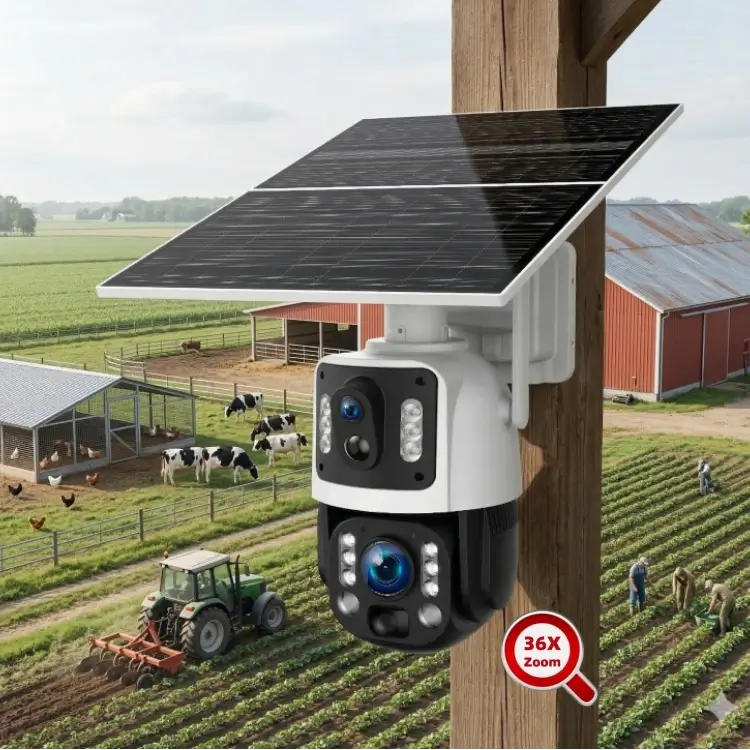
20Ah High-Density Battery: The Heart of Continuous Operation
The core of a weather-resistant system is the Battery Management System (BMS). In our professional line, we utilize a 20Ah high-density lithium configuration, typically housing 8 high-performance 18650 cells. Unlike standard 5Ah or 10Ah units found in mass-market devices, this 20Ah capacity acts as a massive “energy reservoir.”
The secret to surviving the rainy season lies in the power consumption ratio. By implementing advanced low-power design architecture, we have achieved a standby power consumption as low as 0.003W. This allows the camera to remain in “sleep-wake” mode for weeks without a single photon of direct sunlight. When motion is detected, the 4G module wakes up instantly to transmit high-definition data, ensuring that your construction site security cameras remain active even during the darkest months of the year.
18W Monocrystalline Foldable Panel: Maximizing Every Lux
When the sun is hidden behind thick cloud cover, your solar panel must be capable of harvesting diffuse light. Standard glass-covered panels often suffer from reflection and poor low-light conversion. We employ 18W monocrystalline silicon panels designed with a foldable, high-conversion structure.
The “foldable” design serves a dual purpose. Beyond optimizing logistics for bulk shipping to global distributors, it provides a significantly larger surface area for photon absorption compared to compact, fixed-panel alternatives. This increased surface area is critical during the winter solstice in Northern Europe, where the sun sits low on the horizon and daylight hours are severely restricted.
| Feature | Consumer-Grade Camera | Pro-Level Solar Solution (SDL500) |
|---|---|---|
| Battery Capacity | 5Ah – 10Ah | 20Ah (8x 18650 Cells) |
| Standby Power | 0.05W – 0.1W | 0.003W |
| Solar Panel | 5W – 8W (Fixed) | 18W (High-Efficiency Foldable) |
| Weather Reliability | 3-5 Days Cloudy | 20+ Days Cloudy |
Case Analysis: Norway’s Winter vs. Thailand’s Monsoon
Deployment in extreme environments requires more than just capacity; it requires thermal resilience. In the sub-zero temperatures of Norway, standard batteries suffer from extreme voltage drops, causing “fake empty” power indicators. Our BMS technology actively manages charge/discharge cycles to ensure the battery cells stay within a safe operating temperature range even at -20°C.
Conversely, in the high-humidity, cloud-heavy monsoons of Thailand, the challenge is constant gray-sky conditions. By utilizing a high-efficiency MPPT (Maximum Power Point Tracking) controller, our system extracts the maximum possible voltage from the solar panel, even when the solar output is only 10% of its rated capacity. This ensures that even during a three-week rainy streak, the device maintains enough charge to continue reporting.
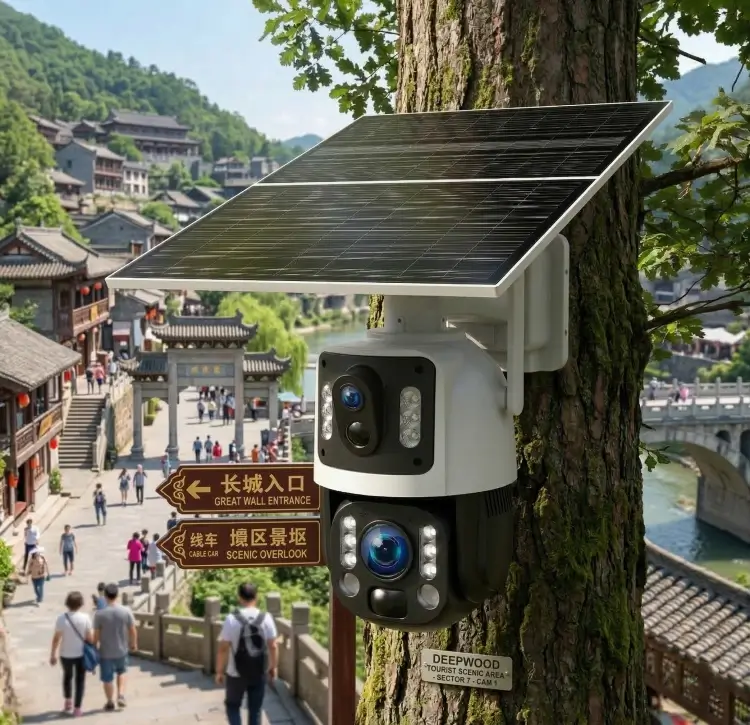
Reliability Checklist for Remote Deployments
- Verify the BMS: Ensure the manufacturer provides data on battery performance in temperatures below freezing.
- Calculate Power Budget: Estimate your daily motion triggers. If you expect more than 50 triggers per day, ensure your solar panel wattage is at least 15W.
- Check Network Stability: Always pair high-capacity solar setups with high-gain 4G antennas to compensate for weaker signal reception in remote areas.
- Strategic Placement: Even with high-efficiency panels, angle the unit toward the equator to maximize light absorption throughout the year.
For engineering firms and brand owners looking to eliminate downtime in their projects, moving to a professional-grade solar camera system is the only way to ensure long-range surveillance reliability. Whether you are monitoring building sites or remote environmental stations, we provide the technical expertise to tailor the power architecture to your specific regional climate.
Are you currently struggling with equipment downtime in your projects? Contact our engineering team today to discuss how our custom battery configurations and solar optimizations can stabilize your deployment, regardless of the local weather forecast.