
Cold-Resistant Surveillance for Canadian Farms: Why the SDL500 Thrives in -30°C to 60°C
For farm owners in provinces like Alberta, Saskatchewan, or Ontario, winter is more than just a season; it is a rigorous endurance test for technology. Standard security cameras often fail when the mercury drops below -10°C. Batteries lose their charge, plastic housings become brittle, and internal circuits succumb to condensation. This leaves expensive equipment, livestock, and remote property vulnerable during the harshest months of the year.
As an engineer with 13 years of experience in solar security camera design, I have analyzed countless field failures in high-latitude regions. The primary culprit is rarely the lens or the sensor, but rather the power management system’s inability to handle extreme thermal swings. The SDL500 was engineered specifically to bridge this gap, offering a robust operating range of -30°C to 60°C, ensuring that “off-grid” truly means “always on.”
In this guide, we will explore the technical requirements for cold-weather surveillance and why the SDL500 is the ultimate battery powered security camera manufacturer solution for the Canadian agricultural sector and other extreme environments.
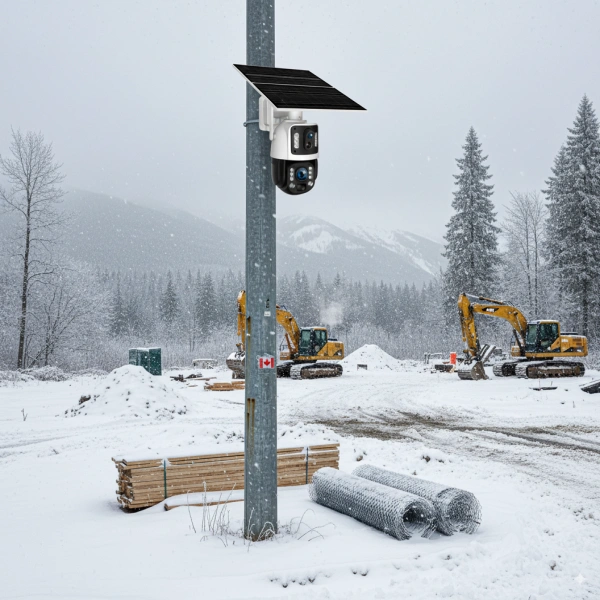
The Science of Cold: Why Standard Solar Cameras Fail in Canada
Most consumer-grade solar cameras use standard Lithium-ion (Li-ion) batteries. While efficient in temperate climates, Li-ion chemistry undergoes a “sluggish” chemical reaction in sub-zero temperatures. At -20°C, a standard battery might only deliver 30% of its rated capacity. More critically, charging a standard battery below freezing can cause permanent “lithium plating,” leading to total battery failure within a single winter season.
The SDL500 addresses this through advanced Battery Management Systems (BMS). Our engineering team implemented a low-temperature charging protection circuit that prevents the solar panel from pushing current into the cells until the internal temperature reaches a safe threshold. You can learn more about how we protect these systems in our deep dive on BMS technology for solar security cameras.
Furthermore, Canadian farms are often located in “dead zones” where Wi-Fi is non-existent. Relying on a standard wireless setup is a recipe for signal drops. This is why the integration of 4G LTE technology is vital. For a detailed breakdown of which connection suits your land, see our comparison on 4G vs WiFi solar cameras.
Core Technical Comparison: Standard vs. SDL500 High-Endurance Series
To help wholesalers and project contractors understand the value proposition, the following table compares the SDL500 series against standard outdoor solar cameras often found on retail platforms.
| Feature | Standard Solar Camera | SDL500 Extreme Series |
|---|---|---|
| Operating Temp | -10°C to 45°C | -30°C to 60°C |
| Battery Chemistry | Standard Li-ion (Non-insulated) | Cold-Resistant LFP with Thermal Layer |
| Connectivity | Wi-Fi Only (Limited Range) | 4G LTE + High-Gain External Antenna |
| Housing Material | ABS Plastic (Prone to cracking) | Engineered Polycarbonate / Aluminum Alloy |
| Night Vision | Standard IR (Black/White) | Smart Dual-Light (Color Night Vision) |
As a long range solar security camera supplier, we prioritize structural integrity. The SDL500 uses a specialized UV-stabilized coating that prevents the casing from becoming brittle after months of exposure to high-intensity snow-glare and UV radiation, a common issue in northern climates.
Smart Dual-Light (SDL) Technology: More Than Just Visibility
The “SDL” in SDL500 stands for Smart Dual-Light. In the vast darkness of a rural Canadian farm, traditional infrared (IR) night vision often results in “washed out” images where details like license plates or facial features are lost. Our technology intelligently switches between invisible IR for covert monitoring and high-intensity LED floodlights when motion is detected.
This serves two purposes: First, it provides full-color video evidence, which is significantly more useful for law enforcement. Second, the sudden activation of light acts as a psychological deterrent to intruders or predators (such as coyotes or bears). For those protecting livestock, the floodlight dual lens solar security camera configuration offers a wider field of view, covering more acreage with fewer devices.
If your project involves high-security zones, the integrated siren and flash alarm features are essential. Explore our siren and flash alarm solutions to see how these proactive measures reduce theft rates by up to 60% compared to passive recording devices.
Application Case Study: Cattle Ranching in Alberta
Problem: A large-scale cattle rancher in Alberta experienced significant loss of calves during the winter due to predators. The calving barn was located 2 kilometers from the main house, making traditional Wi-Fi impossible and trenching power cables too expensive (estimated at $15,000 USD).
Solution: We deployed five SDL500 4G units equipped with high-gain antennas. These units were mounted on timber poles at key perimeter points. Because these are wireless outdoor security cameras, installation took only two hours per unit, requiring no specialized electrical labor.
Result:
- Zero Downtime: Despite a two-week cold snap where temperatures dipped to -32°C, the cameras remained online thanks to the low-temp BMS.
- Cost Savings: The total project cost was under $3,000 USD, a fraction of the cost of wired infrastructure.
- Livestock Protection: The Smart Dual-Light system successfully deterred three predator incursions, with the rancher receiving real-time alerts on his smartphone via the 4G network.
Overcoming the “Dark Months”: Solar Efficiency in Low-Light Regions
Canadian winters are notorious for short daylight hours. A camera that relies on a small, integrated solar panel will likely run out of power by December. The SDL500 is designed for high-efficiency energy harvesting. By utilizing monocrystalline silicon panels with a conversion rate of 22-24%, the system can generate sufficient power even on overcast days.
For industrial applications like building site security cameras, we often recommend an external, oversized solar panel kit. This allows the camera to be mounted in the shade while the panel is positioned 5-10 meters away in direct sunlight. This flexibility is a hallmark of our construction site security solutions, where site layouts change weekly.
Troubleshooting & Maintenance Checklist for Cold Weather
Even the best engineering requires a basic maintenance strategy. As an engineer, I advise our B2B partners to provide this checklist to their end-users to ensure 99.9% uptime:
- Snow Clearance: Heavy snowfall can cover solar panels. Ensure panels are mounted at a 45-60 degree angle to allow snow to slide off naturally.
- Firmware Updates: Always keep the software updated. Our latest updates often include optimized power-saving modes for winter. Refer to our guide on low power camera technology for more efficiency tips.
- Signal Check: In remote areas, snow density can occasionally interfere with 4G signals. Position the camera’s antenna vertically for optimal reception. For extremely remote areas, consider our mini solar PTZ options which offer high-gain connectivity in a compact form.
The Future of Agricultural Security
The demand for resilient, off-grid surveillance is growing. Beyond just security, these cameras are being used for smart agriculture, allowing farmers to monitor water levels, crop growth, and weather conditions from their homes. We are also seeing a rise in the use of hunting cameras with GPS for tracking wildlife and managing large estates.
For wholesalers and brands looking to enter the Canadian or Northern European markets, the SDL500 represents a “no-compromise” product. It eliminates the high return rates associated with “cheap” solar cameras that die during the first frost. By investing in cold-resistant technology, you are building long-term trust with your clients and reducing your after-sales support costs.
The Key Advantages
- Extreme Thermal Range: Reliable operation from -30°C to 60°C.
- Advanced Power Management: BMS technology designed for high-latitude winter cycles.
- High-Definition Deterrence: Smart Dual-Light for color night vision and active defense.
- B2B Customization: We offer OEM/ODM services for battery powered security camera suppliers looking for specific branding or technical tweaks.
If you are a distributor or a security contractor looking for a reliable partner to supply high-endurance solar cameras for the Canadian market or similar climates, contact us at UBOXCAM. We specialize in providing the engineering expertise and production capacity to meet the world’s toughest environmental challenges.
Explore our full range of outdoor solar security cameras and find the right model for your next project.