
Extreme Cold in the Yukon? Why the SDL500 is the Ultimate Arctic Solar Camera
Operating security equipment in regions like the Yukon, Northern Canada, or Scandinavia presents a unique set of engineering challenges. When temperatures plummet to -40°C (-40°F) and the sun barely peeks over the horizon for a few hours a day, standard security cameras simply stop working. Batteries lose their ability to hold a charge, electronic components become brittle, and the lack of a traditional power grid makes traditional surveillance impossible.
As an engineer with over 13 years in solar security design, I have seen countless “off-the-shelf” solutions fail in the Arctic Circle. These failures are usually due to inadequate Battery Management Systems (BMS) and poor thermal management. To address these pain points for B2B clients, 4G operators, and construction contractors, we developed the SDL500—a high-performance long-range solar security camera specifically optimized for extreme cold and off-grid environments.
In this technical deep dive, we will explore why the SDL500 outperforms standard models in sub-zero conditions and how our specialized production process ensures reliability where others fail.
The Technical Battle: Cold vs. Battery Chemistry
The primary point of failure for any battery-powered security camera in the Yukon is the power cell. Most consumer-grade cameras use standard Lithium-ion or LiFePO4 batteries. While LiFePO4 is safer, it typically cannot be charged below 0°C without permanent damage. In the Arctic, this means your camera becomes a “brick” the moment winter hits.
The SDL500 solves this through a dual-pronged approach. First, we utilize high-density ternary lithium batteries or specialized low-temperature LiFePO4 cells with integrated heating films. Second, our proprietary BMS technology monitors the internal temperature of the battery pack. If the temperature drops too low, the system diverts solar energy to an internal heating element before allowing the charging cycle to begin. This ensures the battery remains within its optimal operating window, even when the external environment is frozen solid.
For B2B distributors and engineering firms, this means fewer maintenance trips to remote sites. When you are deploying building site security cameras in northern latitudes, the cost of a single service call can exceed the price of the camera itself. Reliability is the only metric that matters.
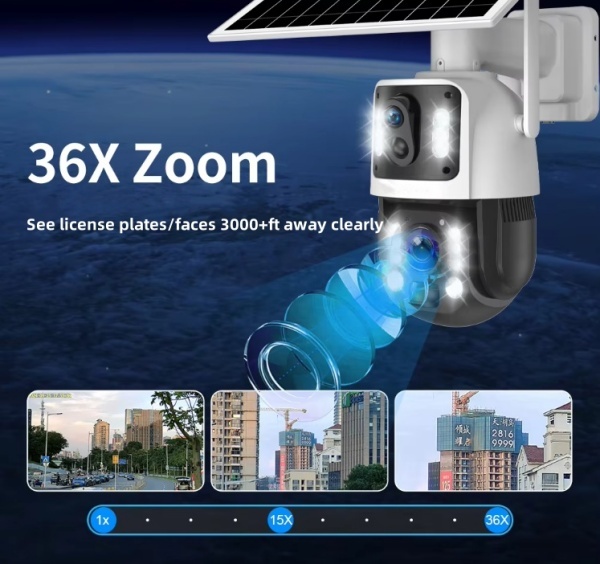
Optimizing Solar Intake During the “Polar Night”
During a Yukon winter, the sun’s angle is extremely low, and daylight hours are minimal. A standard horizontally mounted solar panel will fail to capture enough photons to keep the system running. The SDL500 features a high-efficiency monocrystalline silicon panel with a conversion rate of up to 23.5%. More importantly, our bracket design allows for steep vertical adjustment to catch the low-angle Arctic sun and to prevent snow accumulation from blocking the cells.
Furthermore, the SDL500 is a low-power camera at its core. By utilizing advanced PIR (Passive Infrared) and AI-driven radar detection, the camera remains in a “hibernation” state, consuming only micro-amps of current until motion is detected. This efficiency allows the system to remain operational for up to 15-20 days without direct sunlight, providing peace of mind during the darkest months of the year.
Core Comparison: Standard Solar Cameras vs. SDL500 Arctic Edition
| Feature | Standard Solar Camera | UBOXCAM SDL500 Arctic Edition |
|---|---|---|
| Working Temp | -10°C to 50°C | -45°C to 60°C |
| Battery Tech | Standard Li-ion (No Heating) | Low-Temp Cells with Auto-Heating BMS |
| Connectivity | WiFi only (Limited Range) | Global 4G LTE + High-Gain Dual Antennas |
| Night Vision | Basic Infrared | Smart Dual-Light (Starlight + Full Color) |
| Solar Panel | Fixed 5W – 10W | Adjustable 30W – 60W High-Efficiency Mono |
Why 4G Connectivity is Mandatory for Remote Sites
In regions like the Yukon, infrastructure is sparse. There is no WiFi in the middle of a mining exploration site or a remote highway construction project. This is where what is a 4G security camera becomes the critical question for buyers. Unlike WiFi cameras that rely on a local router, the SDL500 connects directly to the cellular network.
We work closely with 4G operators to ensure our modems are compatible with the specific bands used in Canada (Rogers, Bell, Telus) and the US (AT&T, T-Mobile). For projects involving logistics and transportation monitoring, this ensures real-time alerts and live-view capabilities regardless of how far the site is from civilization.
The SDL500 also supports high-gain antennas, which are vital in areas with weak signal penetration. By utilizing a long-range wireless camera architecture, we ensure that the data transmission remains stable even during heavy snowstorms or atmospheric interference common in high-latitude regions.
Application Case: Protecting Critical Infrastructure in the North
Problem: A telecommunications provider in the Yukon needed to monitor remote relay towers. The site had no electricity, temperatures regularly hit -42°C, and heavy snow was a constant threat. Standard cameras failed within the first week due to battery depletion and frost on the lens.
Solution: We deployed the SDL500 4G Solar PTZ Camera. We customized the firmware to prioritize radar detection over PIR to avoid false triggers from blowing snow and equipped the units with 60W solar panels mounted at a 75-degree angle.
Result: The units maintained 100% uptime throughout the winter. The integrated BMS heating allowed the batteries to charge during the 4 hours of daily sunlight, and the siren and flash light alarm system successfully deterred unauthorized personnel from the site. The client reduced their inspection flights by 70%, saving thousands in operational costs.
Advanced Night Vision: Smart Dual-Light Technology
In the Arctic, “night” can last for 20 hours. Traditional infrared (IR) night vision provides only black-and-white images, which often lack the detail required for forensic evidence (such as vehicle color or clothing patterns). The SDL500 utilizes floodlight dual-lens technology and Smart Dual-Light modes.
- Infrared Mode: Uses invisible IR LEDs for covert monitoring in complete darkness.
- Full-Color Mode: Activates powerful white-light LED floodlights when motion is detected, capturing high-definition color video.
- Smart Mode: Stays in IR mode until a human or vehicle is detected, then switches to color and triggers the strobe alarm to ward off intruders.
This is particularly effective for construction site security, where the visual deterrent of a floodlight turning on is often enough to stop a theft before it happens.
Maintenance and Troubleshooting in Polar Environments
Even the best equipment requires an understanding of the environment. Here is a quick guide for engineers and installers managing solar cameras in the Yukon:
- Snow Clearing: While the SDL500’s steep panel angle helps, extreme blizzards can still coat the panel. We recommend using a hydrophobic coating on the solar glass to minimize adhesion.
- Signal Strength: In deep valleys, cellular signals may bounce. Use our 1000 ft wireless extension kits to place the antenna at a higher elevation than the camera itself if necessary.
- Lens Fogging: The SDL500 uses a vacuum-sealed housing with industrial-grade desiccant packets to prevent internal condensation when the temperature fluctuates rapidly.
- Mounting: Ensure the mounting pole is anchored below the frost line. Heaving soil in the Yukon can tilt poles, misaligning the solar panel’s path to the sun.
Market Trends: Why B2B Buyers are Moving Toward Solar
The global shift toward sustainable energy and the rising cost of labor have made solar security cameras a high-potential business model for 2025. In the B2B sector, the demand is no longer just for “a camera,” but for a “complete off-grid solution.”
As a battery-powered security camera manufacturer, we are seeing a massive influx of interest from government and municipal projects. Whether it’s for municipal infrastructure or environmental monitoring in wildlife zones, the ability to deploy a 4G-connected, solar-powered unit in minutes—without trenching cables—is a game changer for ROI.
Conclusion: Engineering for the Extreme
The Yukon and the Arctic Circle are unforgiving to poorly designed electronics. For wholesalers, retailers, and project managers, choosing the right partner is about more than just the lowest price; it’s about choosing a product that survives the winter. The SDL500 represents the pinnacle of our 13 years of engineering experience, combining robust battery technology, high-efficiency solar harvesting, and reliable 4G connectivity.
If you are looking to secure a remote site, expand your product line with high-performance Arctic-grade cameras, or need a customized OEM solution for your brand, UBOXCAM is ready to deliver. Our factory specializes in tailoring these systems to meet the exact frequency bands and environmental ratings required for your specific region.
Don’t let the cold shut down your surveillance. Explore our full range of wireless outdoor security cameras today and see how we can keep your perimeter protected, even at -40°C.