
Battery Maintenance and Winter Care: Professional Advice for Extending the Lifespan of Solar Security Cameras
For distributors and project integrators in regions like Canada, Germany, and the Northern United States, winter is the ultimate “stress test” for outdoor security hardware. As a design engineer with 13 years in the solar security industry, I have seen countless 4G solar cameras fail not because of hardware defects, but due to poor battery management and environmental neglect during the colder months.
When the temperature drops below freezing, the chemical activity within lithium batteries slows down significantly. This leads to reduced capacity, slower charging speeds, and, in extreme cases, permanent cell damage. For a business owner or an Amazon seller, this translates to high RMA (Return Merchandise Authorization) rates and damaged brand reputation. Understanding the technical nuances of battery maintenance is not just about “care”—it is about protecting your investment and ensuring 24/7 uptime for critical surveillance.
The Science of Cold: How Winter Affects Solar Camera Batteries
Most low-power cameras today use either Ternary Lithium (NCM) or Lithium Iron Phosphate (LiFePO4) batteries. While LiFePO4 is safer and has a longer cycle life, it is notoriously sensitive to cold. Charging a standard LiFePO4 battery below 0°C (32°F) can cause “lithium plating,” an irreversible process that creates internal short circuits.
This is where a high-quality Battery Management System (BMS) becomes the unsung hero of your security system. A professional-grade BMS, like those we integrate at UBOXCAM, monitors temperature sensors in real-time. If the temperature is too low, the BMS will cut off the charging circuit to prevent damage, even if the solar panel is receiving full sunlight. Understanding this mechanism helps explain why a camera might show “not charging” on a bright but freezing January morning.
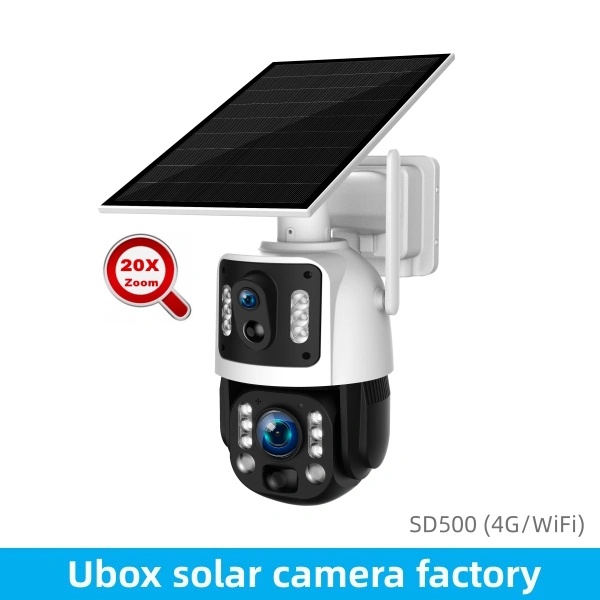
Core Comparison: Standard vs. Winter-Optimized Solar Systems
To help wholesalers and brand owners choose the right product for their market, the following table compares the performance of standard consumer-grade cameras versus professional-grade winterized solutions.
| Feature | Standard Solar Camera | Professional Winter-Optimized (UBOXCAM) |
|---|---|---|
| Battery Chemistry | Standard Li-ion / LiFePO4 | Low-temp resistant cells or NCM options |
| BMS Protection | Basic Overcharge/Discharge | Advanced BMS with Temp-Compensation |
| Solar Efficiency | 15% – 18% Efficiency | 22%+ Monocrystalline Silicon Panels |
| Operating Temp | -10°C to 50°C | -30°C to 60°C (with thermal insulation) |
| Standby Power | High (Constant 4G ping) | Ultra-low power sleep mode (< 2mA) |
5 Professional Tips for Winter Maintenance
Maintaining wireless outdoor security cameras in harsh conditions requires a proactive approach. Here are the strategies we recommend to our global partners:
- Optimize the Solar Angle: In winter, the sun sits lower on the horizon. If your panel is fixed at a “summer angle,” you could be losing up to 40% of potential energy. Adjust the panel to a steeper angle (Latitude + 15 degrees) to capture maximum photons and allow snow to slide off easily.
- Clean the Photovoltaic Surface: Dust, bird droppings, and salt spray from winter roads create “hot spots” on solar panels, reducing efficiency. A simple wipe-down with a microfiber cloth every quarter can extend the battery’s state of charge significantly.
- Firmware Power Management: Encourage users to switch to “Power Saving Mode” during months with low sunlight. This reduces the PIR trigger frequency and limits the length of recorded clips, ensuring the battery-powered security camera doesn’t reach a 0% state, which is lethal for lithium cells in the cold.
- Snow Clearing: Even a thin layer of snow can completely block energy production. For high-altitude installations, we recommend panels with hydrophobic coatings that prevent ice adhesion.
- Pre-Winter Full Charge: Before the first deep freeze, ensure the battery is charged to 100%. A fully charged battery has a lower freezing point and more “buffer” to withstand consecutive cloudy days.
Case Study: Reliable Monitoring in the Canadian Wilderness
The Problem: A construction firm in Alberta, Canada, needed to secure a remote site with no power grid. They initially used consumer-grade 4G cameras, but the units died within 48 hours during a -20°C cold snap, leaving the site vulnerable to theft.
The Solution: We deployed our SL100-4G construction site security cameras. These units feature high-capacity NCM batteries specifically chosen for their low-temperature discharge curve and a high-gain 4G antenna for remote areas.
The Result: Despite three weeks of sub-zero temperatures and limited sunlight, the cameras maintained a 98% uptime. The client reduced site losses by 85% and eliminated the cost of sending technicians to manually recharge batteries in the field. This demonstrates why choosing a battery-powered security camera manufacturer with engineering depth is critical for B2B success.
Troubleshooting Common Winter Issues
If your clients report issues during the winter, use this quick diagnostic guide to provide expert support:
- Q: The camera shows “Offline” early in the morning.
A: This is likely a voltage drop due to cold. Check the battery percentage. If it’s below 20%, the 4G module may shut down to protect the core system. Recommend a steeper solar panel angle. - Q: The PIR sensor seems less sensitive.
A: PIR sensors work by detecting heat signatures against the background temperature. In extreme cold, the “contrast” between a human body and the environment is high, but the sensor’s own circuitry may slow down. Adjust sensitivity to “High” in the app settings. - Q: The camera is connected but not recording.
A: Check the SD card. Standard SD cards often fail in freezing temperatures. Ensure you are using “Industrial Grade” or “High Endurance” cards rated for -25°C.
Market Trends: The Future of Low-Power Surveillance
The global solar security camera market is moving toward “AI at the Edge.” By processing motion detection locally on the chip rather than waking up the cloud-connected 4G module for every movement, we can reduce power consumption by another 30%. This “smart wake-up” technology will be the key to 365-day operation in Northern Europe and North America.
Furthermore, the integration of long-range wireless technology is allowing solar cameras to be placed further away from gateways, necessitating even better battery management to handle the increased transmission power requirements.
Selection Checklist for Professional Buyers
When sourcing solar cameras for your project or retail brand, use this checklist to ensure winter durability:
- Does the unit have a dedicated BMS with low-temperature charging protection?
- Is the 4G module optimized for low-signal, low-power consumption?
- Is the solar panel detachable for flexible mounting in shaded areas? (See our S10-4G mini solar PTZ for examples).
- Does the manufacturer provide detailed discharge data for sub-zero environments?
- Is the housing rated at least IP66 to prevent ice expansion from cracking the casing?
Conclusion: The Value of Engineering Excellence
In the world of B2B security, reliability is the only currency that matters. Winter maintenance is not just a list of chores; it is a technical strategy to ensure that a solar powered security camera performs its duty when the environment is most hostile. By choosing products designed with BMS intelligence and high-efficiency photovoltaic cells, you reduce your long-term operational costs and build a reputation for quality.
If you are looking to source high-performance, low-power 4G solar cameras for your next project, explore our range of long-range solar security solutions or contact our engineering team at UBOXCAM for customized OEM/ODM specifications tailored to your climate.