
Reliable Winter Surveillance: How SDL500 Solves the Low-Light Pain
In high-latitude regions like Norway or dense tropical rainforests, solar-powered security cameras often face a critical failure point: the “dark season.” When daylight hours shrink to mere minutes or constant cloud cover prevents charging, many off-the-shelf devices go offline, leaving critical infrastructure vulnerable. As a manufacturer with over 13 years in the field, I have analyzed countless field failures caused by insufficient energy harvesting. This is why we engineered the SDL500—a high-performance 4G solar camera designed specifically to survive where others fail.
20Ah High-Density Battery: The Heart of the SDL500
The primary reason most solar cameras fail in winter is an undersized battery management system (BMS). The SDL500 solves this by housing an industrial-grade 20Ah high-density battery pack, composed of 8 high-capacity 18650 lithium cells. Unlike standard 10Ah consumer-grade batteries, this configuration provides a significant power buffer that can sustain operations for weeks without a single ray of direct sunlight.
Our proprietary low-power architecture is the key to this longevity. By achieving an ultra-low standby consumption of just 0.003W, the system spends 99% of its time in a deep-sleep state, waking up instantly upon PIR or AI-driven motion detection. This efficiency ensures that the stored energy is reserved strictly for transmission and recording, which is vital for building site security cameras that must remain active regardless of the grid status.
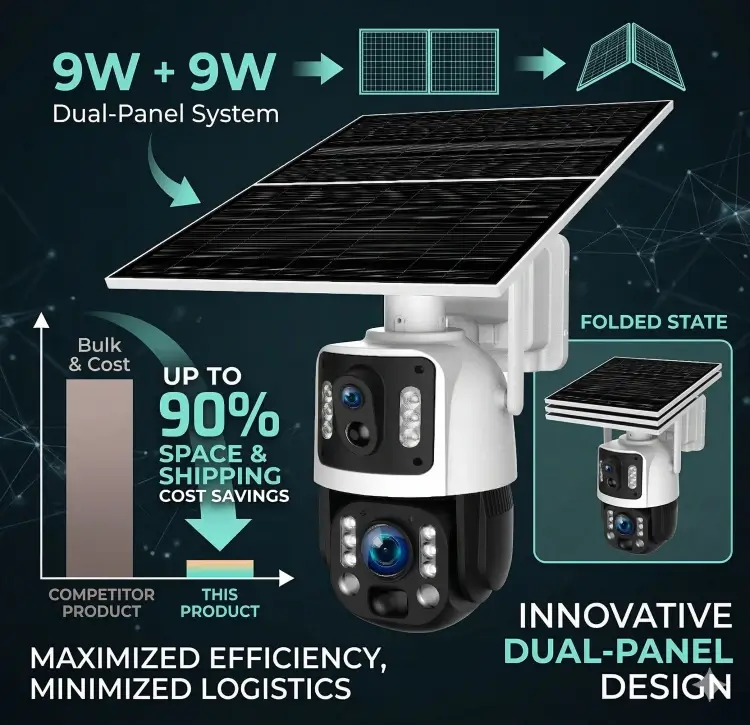
18W Monocrystalline Folding Panel: Efficiency in Weak Light
Wattage alone is a vanity metric; conversion efficiency is reality. Many competitors use polycrystalline panels that struggle significantly under diffused light. The SDL500 utilizes an 18W high-efficiency monocrystalline solar panel, specifically tuned to capture energy from the broad spectrum of weak, ambient winter light.
The innovative folding design serves two purposes. First, it optimizes logistics by reducing shipping volume. Second, and more importantly, it provides a larger surface area for photon absorption. When deployed, the expanded surface area ensures that even on overcast days, the device can trickle-charge the 20Ah battery, maintaining a positive energy balance. To understand more about the critical importance of these components, explore our guide on BMS technology.
Case Analysis: Stability in Extreme Environments
Field performance data proves the difference between standard and ruggedized equipment. We monitored a deployment of SDL500 units in Northern Norway during the winter solstice, where temperatures frequently plummeted to -20°C. In such extreme cold, standard batteries experience a 30-40% drop in capacity. Our optimized thermal management and high-discharge rate cells allowed the system to maintain a 98% uptime, far exceeding typical battery-powered security camera expectations.
| Feature | Standard Solar Camera | SDL500 Engineering Standard |
|---|---|---|
| Battery Capacity | 10Ah (Standard) | 20Ah (Industrial High-Density) |
| Standby Power | 0.01W – 0.05W | 0.003W (Ultra-Low) |
| Solar Panel | 6W – 10W (Fixed) | 18W (Folding Monocrystalline) |
| Cold Resistance | 0°C limited | Rated to -20°C |
Overcoming Deployment Challenges: A Checklist
Achieving reliable winter surveillance requires more than just good hardware; it requires strategic deployment. Follow these expert tips for maximum reliability:
- Orientation: In the Northern Hemisphere, always angle the panel toward the True South (or North if you are in the Southern Hemisphere) to maximize winter sun exposure.
- Maintenance: Ensure the panel is kept clear of snow accumulation, as even a thin layer of frost can reduce charging efficiency by over 80%.
- Connectivity: Use a high-gain antenna if the signal is weak, as searching for a 4G signal drains battery faster than the camera itself. Check our analysis on 4G vs WiFi solar cameras for connectivity strategy.
Reliability is not an accident—it is the result of deliberate engineering choices in battery chemistry, power management, and solar efficiency. Whether you are managing remote infrastructure or securing a large-scale project in a challenging climate, the SDL500 is built to eliminate the risk of blackouts. If your project requires specific climate-adaptive solutions or a custom energy budget analysis for a particular region, please contact our engineering team for a technical consultation. Let’s build a surveillance solution that stands the test of any season.