
Surviving the Winter: Why Pro Solar Cameras with 18W Foldable Panels Are the Game Changer
For security contractors and project managers operating in high-latitude regions or tropical rainforest climates, the “winter blues” take on a literal meaning: total system failure. The most common pain point I hear from clients in Northern Europe and Southeast Asia is the nightmare of frequent power depletion during prolonged periods of low sunlight or relentless cloud cover. When your wireless outdoor security cameras go offline, your liability rises instantly. As an engineer with over 13 years of experience in solar-powered surveillance, I have learned that the key to 24/7 reliability isn’t just about having a panel; it’s about energy equilibrium.
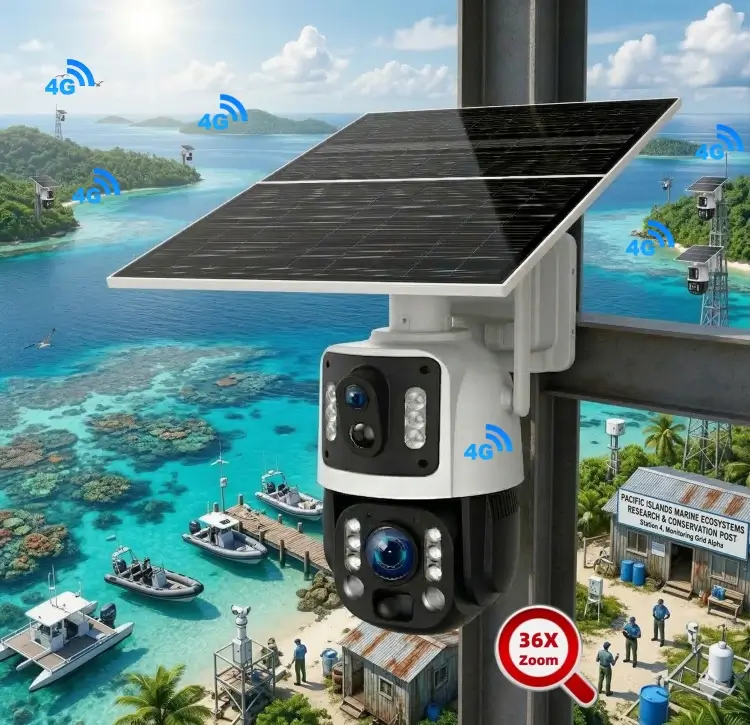
20Ah High-Density Battery: The Powerhouse Behind the SDL500
The core of any robust off-grid system is its energy reservoir. Standard consumer-grade solar cameras often fall short because they utilize small, low-capacity lithium batteries that struggle to bridge the gap during three to five days of zero direct sunshine. The SDL500 architecture, however, is built around a massive 20Ah high-density battery bank, housing eight industrial-grade 18650 cells.
By implementing a deep-cycle battery configuration, we ensure that even during peak winter months, the camera remains operational. We have optimized our hardware to achieve an ultra-low power standby consumption of just 0.003W. This is critical for low-power camera reliability. When the PIR sensor detects motion, the system wakes instantly, records, and pushes an alert before returning to its ultra-frugal sleep state. This intelligent power management is what keeps systems alive when other brands simply shut down.
The 18W Foldable Monocrystalline Panel: Maximizing Every Lux
Efficiency in weak light is where traditional fixed-panel systems fail. Many off-grid projects rely on standard 5W or 6W panels that require perfect perpendicular sun exposure. In contrast, our 18W foldable monocrystalline panel design offers a twofold advantage. First, the high-efficiency monocrystalline cells maintain a higher conversion rate even under overcast, diffuse lighting conditions.
Second, the foldable design solves a logistical and physical challenge. It allows for a significantly larger surface area, capturing photons that a compact, fixed-lens unit would miss. Whether you are managing building site security or remote wildlife monitoring, this expanded surface area acts as your safety net. In low-light environments, every square centimeter of solar surface matters.
| Feature | Standard 6W Fixed Panel | 18W Foldable Panel (Pro) |
|---|---|---|
| Conversion Efficiency | ~19% | >23% (High-Grade Monocrystalline) |
| Cloudy Day Performance | Minimal/System Shutdown | Consistent Trickle Charge |
| Deployment Flexibility | Fixed Orientation | Adjustable/Optimal Sun Angle |
| Best For | Sun-drenched regions | High-latitude & Tropical areas |
Case Study: Reliable Operations in Norway and Thailand
To prove our engineering strategy, consider two extremes. In Norway, our team deployed units during the dark winter months where temperatures consistently hover around -20°C. Cold-weather performance is notoriously difficult for lithium chemistry. We engineered a specific BMS (Battery Management System) to monitor internal resistance and prevent charging if the battery temperature drops below zero, coupled with high-capacity storage that mitigates the loss of efficiency due to extreme cold.
In Thailand’s monsoon season, the challenge isn’t temperature, but the lack of direct solar radiation. The 18W foldable panel captures enough diffuse light from the overcast sky to keep the 20Ah battery bank topped off. In both scenarios, the result is a stable, persistent surveillance network that does not require manual intervention—a massive cost-saver for long-range solar security camera installers who cannot afford site visits for dead batteries.
Expert Tips for Choosing Your Power System
If you are planning a deployment, don’t just look at the camera specs; look at the power budget. As you evaluate your next project, keep this checklist in mind to ensure long-term, profitable operations:
- Calculate Your Average Sun-Hours: Use meteorological data for your specific region, not just the national average.
- Prioritize Battery Capacity: Ensure your battery can support the camera for at least 7 days of total darkness.
- Choose Monocrystalline: Never compromise on panel quality; polycrystalline loses efficiency too quickly in suboptimal conditions.
- Check the BMS: A high-quality BMS is the difference between a 1-year product and a 5-year asset.
For those looking to expand their portfolio or secure critical infrastructure, integrating professional-grade, weather-resilient hardware is the best way to reduce churn and build client trust. If you are struggling with a specific regional climate—whether it is the frozen north or the cloudy tropics—contact our engineering team today. We can help you customize a solar-plus-storage solution that guarantees your security cameras stay online, regardless of the weather report.